|
Kalavai Special Issue
Issue Date: 08-Nov-2007
1. Mahāsvāmikaḷ and Kalavai:-
Kalavai a small village in North Arcot district, sprang into world wide prominence with the association of Śrī Candraśēkharēndra Sarasvatī svāmikaḷ, the Mahāsvāmikaḷ of Kāñcī Kāmakōṭi pīṭham. Two of his predecessors on the pīṭha attained samādhi merged with (Para-brahmam) in the village where their Bṛndāvan temples are enshrined. Provident brought young Swaminathan (the pre sanyāsa name of Mahāsvāmikaḷ) to Kalavai when he was hardly 13 years of age and was ordained as the Head of the Kāñcī Mutt under the dīkṣā name Candraśēkharēndra Sarasvatī, in this village in 1907. After the country was liberated from the Colonial rule and its associated alien thrust, this Great Ācārya by his divine wisdom and pure and simple life guided the religious destiny of India. (For the history of this noble Ācārya ascending the throne of Kāmakōṭi mutt, pl see part II of this book). He instilled a sense of harmony and spiritual life among the people of India and received veneration from Mahatma Gandhi down to all the leading personalities of India. His Call to the United nations in His celebrated song “Maitrīm Bhajata” - cultivate friendship and harmony among different people of the world, - rendered into soul stirring song by the Supreme musician M.S Subbhalakshmi, echoes even to this day. The Ācārya started his march of peace and spirituality from this village and ever since this village is a place of pilgrimage not only for the devout but all sections of people.
2. Kalavai History:-
The modern village Kalavai, in Wallaja taluk of North Arcot district, Tamilnadu, situated about 120 km from Madras is a village of historic importance from the time of the Pallavas 8th cent. Ancient relics and inscriptions relating to the village are found in the local Śiva temple named Thirukkārīśvara temple. Probably the temple was built by one Thiruk-kāri and hence the name Thiruk-kārīśvara (on anology with Rājarājēśvara). If so the history of the village could be traced to the Saṅgam age. The area was under the control of the Malaiyamāns of Thirukkōyilūr where ruled the famous chiefain Malaiyamā Thiru-mudikkāri who has been sung by eminent Saṅgam poets like Auvaiyār, Paraṇar, and Kapilar. It is not unlikely that Thiruk-kārī of this family built the Śiva temple after whom it came to be called Thiruk-kārīśvaram. The Sthala purāṇa of the village seems to support this antiquity. Its close link to Malaiyanūr may be seen in the sequence.
3. Thirukkārīśvara temple at Kalavai:-
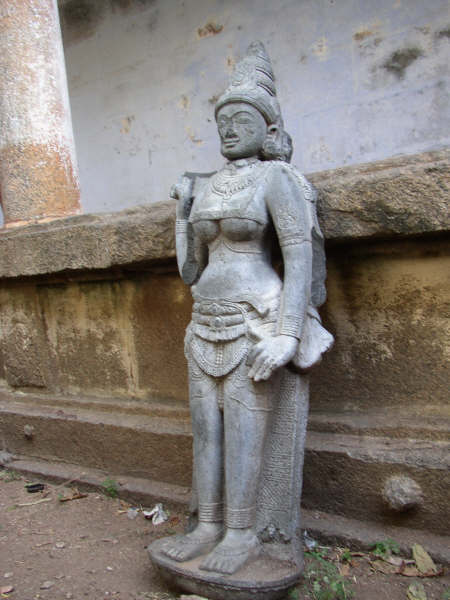
The village Kalavai has been in existence from 7th cent is seen from a Śiva liṅga with sixteen facets on its cylindrical part, a feature found mostly in Pallava temples in Māmallapuram and Kāñcīpuram. It is now found inside the enclosure. Also found is a small Gaṇēśa in stone of the same age in the same temple. A third relic of the Pallava age is that of an exquisite Durgā image in stone assignable to late 8th cent. An aesthetically beautiful sculpture , well proportioned and pleasing in line, volume and posture, this sculpture has unfortunately suffered damage probably due to falling stones or debris. Its head is broken and the hands damaged. Inspite of the mutilated condition this is a remarkable sculpture of the age. These relics suggest that this temple dedicated to Śiva and built of bricks existed from Pallava times 8th cent.
4. Brahmēndra Matha:-
Three years later two ladies, named Amudan-Pangi and Peṟṟāḷ-tavam-ceydāḷ, serving a matha of Brahmēndra, purchased 500 kuḻis of lands each, from one Karuṇākara-bhaṭṭan, a member of the administrative group of the village, and gifted them to the Śiva temple. The first gifted her land for performing nityōtsava, daily festival, and the other for meeting the expenses of naivēdya food offering during the morning worship. This record mentions a canal of the village named Rājarājan-vāykkāl. The lands were measured by standard measures of 16 spans in length.
5. Looting by Malik Kaffoor:-
It is known that in 1310 Malik kaffoor invaded the southern countries and looted the properties of all temples that drained the major wealth and economy of Tamilnadu. After his invasion one Rājanārāyaṇa Sambuvarāya took charge of Toṇḍaimaṇḍalam and ruled with Kāñcī as his capital. He was ruling over Kalavai as well. He ordered in an edict that the taxes levied on some lands of Kalavai village to be remitted and made over to the temples of Kalavai. The farmers refused to cultivate the lands due to crop failures, which necessitated the remission.
6. Kṛṣṇadēvarāya and Sadāśiva Rāya:-
All these inscriptions are found in the Thiruk-kārīśvara temple of the village but there are also inscriptions in nearby villages from where we notice that in the 16th cent, Kṛṣṇadēvarāya, the famous Vijayanagara emperor and Sadāśiva rāya, a successor of him had appointed some people to protect the region and conferred privileges in Kalavaip-paṟṟu. Kṛṣṇadēva rāya granted the right of Thirumēnik-kāval (protecting the temple idols) to one Timmappa nāyaka of Satirappādi on 20th August 1526. Kalavai now appears as a larger territorial division called Kalavai Paṟṟu, a status that it has reached from 13th cent. Evidently the village population has grown. The record of Sadāśiva rāya dated 1550 refers to Kumāra Kṛṣṇappa nāyaka and Bommu nāyaka of Vellore. These Vijayanagara inscriptions are found in a nearby village called Kudinallur. The village Kalavai is now included in the territorial division Perumtimiri nādu.
7. Kārī-Varadap-Perumāḷ temple at Kalavai:-
There are a number of other temples in the village that needs attention. The Viṣṇu temple in the center of the village was in existence from pre 13th cent but seems to have been rebuilt in the Vijayanagara times in 16th cent. The Tāyār shrine was built in 1918 by one Piccai-mutthu chettiyār, son of Chinna-thambi-chettiyār of Pinnan-tāṅgal. The front maṇḍapa of the temple seems to have been built in 1964, when a lady Raṅganāyaki Ammāḷ, wife of Aṇṇāmalai-chettiyār of Pinnan-thāṅgal gifted land for services in the temple The temple is now called Kāri-varada-perumāḷ temple. There exists a temple tank behind this temple with four pillars in the center serving as maiya maṇḍapa (central maṇḍapa inside the tank ). It is learnt that there used take place float festival of Lord Viṣṇu in the tank, within living memory. But now it is filled with dirt and moss and remains unusable. It also contributes to unhealthy environment, serving a breeding ground of mosquitoes. It is learnt that a grand plan to de-silt the tank has been approved for 15 lakhs of rupees and the wok is likely start at anytime.
8. Chandra-śēkhara temple at Kalavai:-
At the outskirts of the village is a small Śiva temple now called Chandra-śēkhara. An inscribed tablet on its base says that it was originally built of brick and remained ruined. One Bhūpālan son of Kumāran (brother of Duraiswami) of Kalavai re-built the temple with stone in 1937. The work was started a year earlier in 1936 with the help of some villagers of Kalavai. On the banks of the rivulet a new temple of Sapta kannis have been housed. It is near this place His Holiness Mahāsvāmikaḷ was ordained as Sanyāsin.
9. Aṅgāḷa paramēśvarī temple:-
Towards the end of 19th cent, a family of Mudaliyārs who were residents of Kalavai but devotees of Mēl-malaiyanūr-Aṅgāḷa paramēśvarī temple took efforts to built the Aṅgāḷa paramēśvarī temple in Kalavai. One Appu Mudaliyār who established the temple and received a yantra from the Kāñcī Śrī Śaṅkarācārya Mahāsvāmikaḷ and consecrated it in the temple. Appu Mudaliyār was succeeded by his efficient son Kaṇṇappa mudaliyār who popularized the temple in Karnataka and Andhra besides Tamilnadu. His statue is placed in the enclosure of the temple. Ever since the worship is in the hand this family. The goddess is seated in the sanctum with four arms holding udukka, and triśūla in the rear arms and sword and varada pose in the front arms. But what is significant is that a large image of the Goddess, over five meters in length, is portrayed in stucco, brightly coloured, with multiple arms wielding weapons, lying face up on the ground in the front maṇḍapa. She is portrayed as if in a Ṣaḍkōṇa (six sided) sacrificial pit. The image is awe inspiring and clothed and decorated with garlands. This temple is attracting large number devotees and believed to cure incurable diseases especially mentally affected patients. Peoples from far off places like even Karnataka and Goa are seen coming here. Thus it is a great pilgrim center Prārtanai sthalam. Secondly it attracts tens of thousands of devotees on the Mahā-Śivarātri day for the Śmaśāna kollai festival when the Goddess is taken in procession to the cemetery.
10. Kamalak-Kaṇṇi temple:-
Adjusant to this is another temple dedicated to Goddess Kamalak-kaṇṇi which also attracts large number of devotees. This is almost identical with the Aṅgāḷa paramēśvarī temple with a sanctum inside and a huge stucco figure of the Goddess in lying position with multiple hands in the front maṇḍapa. This is considered Goddess Mahā-Lakṣmī. This temple was built in 1979 by Swami Saccidānanda who settled here after several years of wanderings in Northern part of India including the Himalayas and other places as a mendicant. This Sanyāsin who remains in the temple premises observes complete silence and does not speak to any for the past sixteen years. He communicates through gestures and also written messages. He is a noble personality, venerated and held in high esteem by the devotees and village people.
11. Renukā Paramēśvarī temple:-
There is another temple of Goddess opposite to these two temples of Goddesses. This temple is dedicated to Renukā dēvi, the mother of Paraśurāma and is adored by Kulālas (the potters) of the village. This temple is famous for the Mahābhārata festival which is conducted annually when the whole of Mahābhārata is recited culminating on the 18th day when Duryodhana’s defeat and death in the hands of Bhīma (the Pāṇḍava hero) is enacted. The assembly of great number of people to witness the festival demonstrates the influence of Mahābhārata on the life of the people here. It is not possible to say how far back this temple goes but the temple has received renovations in recent times.
12. Subrahmaṇya temple:-
There is also a Subrahmaṇya temple in the middle of the Market street. It is possible that a Subrahmaṇya temple existed in the village earlier as seen from a beautiful 16th cent Subrahmaṇya bronze image in the village. However it might have been fallen into disuse. In the beginning of 20th cent one Rukmiṇi ammāḷ of Kalavai village endowed all her wealth for rebuilding the temple of Stone. The temple is in a neat surrounding with a good tank and enclosure. The temple includes a sub-shrine for Lakṣmī Nārāyaṇa and another for Śiva Akilāṇḍēśvara with Goddess Mīnākṣī. The temple attained popularity with His Holiness, the Mahāsvāmikaḷ presenting a yantra for consecration in the temple in the year 1978. Śrī Ethirāja mudaliyār, a resident of Kalavai who is more than 80 years old now, is virtually a living history of Kalavai. He narrated cogently the events that took place in the Village since 1950s. The Subrahmaṇya temple plays an important role in the life of the people of Kalavai.
|