Śiva as the destroyer of three cities is represented frequently in bronze next only to Somāskanda, Nataraja, and Candrasekhara images. This is particularly so in Chola times with the result a large number of Tripurāntaka bronzes exist in worship and some have found their way to
museums.
Textual TraditionTripurāntaka images are called Tripura-samhara-murti, Tripura-sundara, Tripura-vijaya, Purari and by other names. The images may, according to texts, have 2,4,8,or 10 arms. Some texts list eight types of Tripurāntaka images, the differences between them beingmainly in the postures of legs and arms. One may have the right leg planted firmly and the left slightly bent or vice versa. Some may have a dwarf beneath the leg while others may simply be standing on the pedestal. The main arms being in the pose of holding the bow and arrow, their positions are detailed in the texts. Especially the front left arm holding the bow could be above the shoulder, or in level with the arm-pit, or in level with the chest. When the images have four arms the rear right will hold axe and the left deer. When the bow wielding arm is above the shoulder, the rear arm with the deer is brought down to achieve balance. There are some features repeatedly mentioned in most of the texts. Śiva as Tripurāntaka should always be accompanied by his consort Gauri Uma. Of the legs only the left should be placed on the dwarf. These have symbolic as well as deep theological meanings. (Gopinatha Rao.T.A, Elements of Hindu Iconography.) We may examine the known Tripurāntaka bronzes against these textual prescriptions.
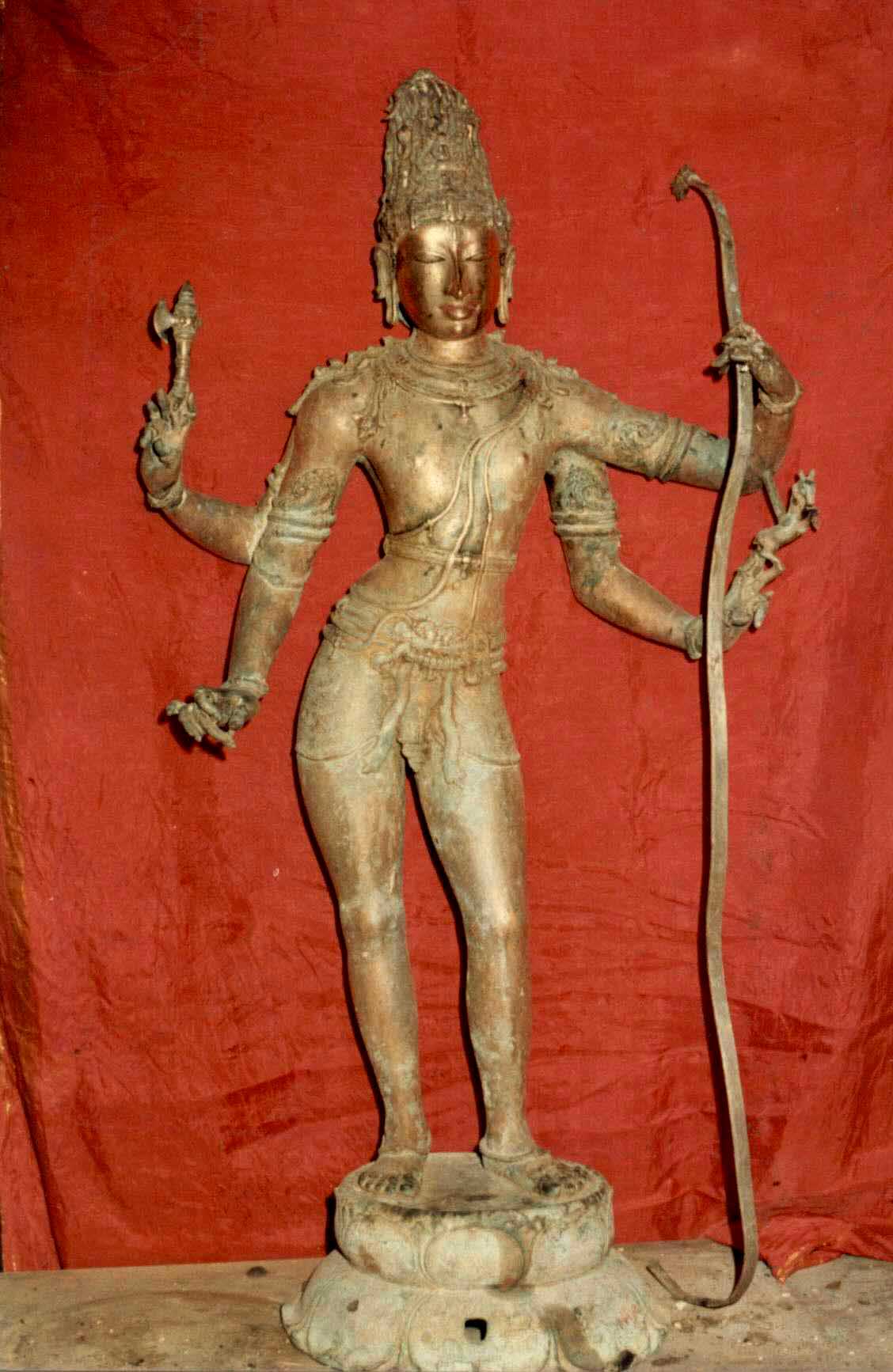
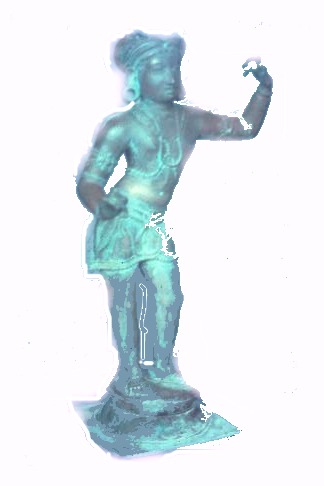
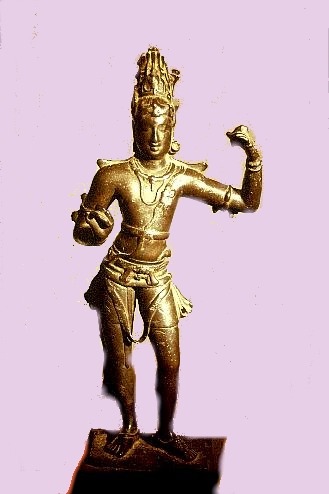
Tripura VijayaTripura Vijaya DevaTripura Vijaya Deva, Koneri Rajapuram, Tanjore Dist., Sembiyan Mahadevi Concecration, 990 C.E. It is better to call this form in bronze as Tripura-Sundara or more appropriately as Tripura-vijaya as called by the Chola Queen Sembiyan Mahadevi in her inscriptions, rather than Tripurāntaka for reasons to be discussed in the sequence. Tripura-vijaya images in bronze are noticed either with two or four arms. No image with more than four arms has been noticed so far. The leg positions do vary but the dwarf when present isfound only beneath the left leg and not beneath the right. In temples where they are still preserved as at Konerirajapuram or Kodumudi, Tripura-vijaya is found with his consort. All Tripura-vijaya bronzes should have the accompanying consort, and where not found they should be taken as present originally, but now lost.
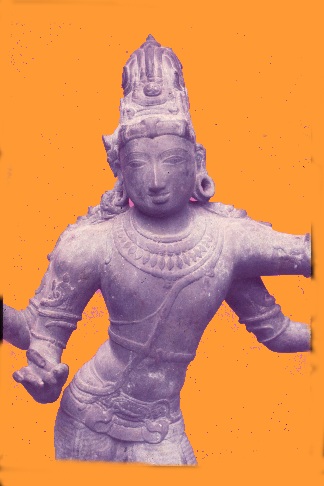
Śiva destroyed the three cities with terrific rage, often called attahasa in literature. His images should depict fury on the face. The furious emotion expressed in the face is called Raudra drishti in Natya Sastra of Bharata. In depicting this pitiless sentiment, the eye balls should be lifted up, rough, and reddish inline. The eyebrows should be kept crooked. (The Natya sastra of Bharata muni, English translation, by a Board of Editors, Delhi. 1981,p 119). The finest portrayal of Śiva as Tripurāntaka in painting comes from the Great temple of Tanjore where the God is shown in great fury with eyebrows raised, the eyes wide open and the pupils shown as rounded balls. The face, in this panel conform to Natya sastra. None of the bronzes so far noticed portray this anger. Clearly the bronzes do not represent the moment of anger but sublime compassion karuna as in the well-known examples of Sarabai collection, the Tanjore art gallery collection and so on. (Ill). We have to take into account bronzes which do not have re-cuttings on the face to determine the original intention of the makers. Since bronze images are processional deities, brought out inprocession to bestow grace, the moment selected for portrayal is the stage immediately after destruction of the Tripuras, when Śiva bestowed boons even on the three vanquished Asuras. So it is the Tripura-vijaya aspect, appropriately called so by Sembiyan-mahadevi, that is depicted in bronzes (Ref. Agamic position.)
Each divine sport is a continuous occurrence of several events. The imagery depicted in the art form is aparticular moment chosen by the maker to yield the desired benediction that the art historian must remember while identifying an image. Tripura-vijaya is the best example to illustrate this point. I would prefer to call them as Tripuravijaya and rather than Tripurāntaka where the emphasis is on the destructive side.
The earliest Tripuara-vijaya inbronze, so far noticed, is under worship in the temple of Kulappadu in Tanjore district and is assignable to the first half of the 8th cent. It is a four-armed image with its left leg on the head of a dwarf. Unfortunately its eyelines have been recut. This Pallava bronze carries in both its rear arms arrows in addition to its front right, a feature not mentioned in texts. The other Pallava bronze of superlative workmanship is the Sarabai collection. The Thiruneipper image (ref.) is perhaps the tallest and datable to 875 AD. The depiction of Tripura vijaya is thus rooted in Pallava times illustrated by these examples.
The Golden Age Of Tripura-vijaya
The Cholas were great devotees of the Tripura-vijaya form. Most of the great pieces of this form were made in the Chola period from 10th to 13th cent. The one set up by Sembiyan mahadevi at Konerirajapuram is undoubtedly the most delightful figure. There are many bronzes of the Chola period in temples, museums and private collections now. A point of great interest is that making Tripura-vijaya images in bronze seems to have diminished after 14th cent, for there are not many images of the later age. This is probably due to enormous popularity gained by the Nataraja icons. The concept of Tripura-samhara merged with the concept of Nataraja as will be explained in the sequence.
All the temples of Śiva should conduct the great annual festivals called Brahmotsava for a number of days generally lasting for nine days. One or more manifestations of Śiva are taken out in procession. The Aghora-sivacharya-paddhati, an influential text states that the image of Tripurāntaka should be taken in procession on the sixth day of the annual festival. (For variations see). All the annual festivals include the car festival, ratha yātra. The texts do give us detailed description, invocation and worship of the car. The temple car is are presentaion of the Chariot made for the destruction of the Tripurasuras mentioned in all agamas and puranas. The deity installed in the chariot is Nataraja and this in a sense depicts the victory dance of Śiva. The car festival should be performed on the 7th day, the day of Nataraja.
The dance of Śiva and the Tripura-dahana as parts of the same events are extolled from very early times in the Tamil country. The sangam works as Purananuru and Kalittokairefer to these forms. The Silappadhikaram speaks in enchanting poetry the dance of Śiva, when he destroyed the three cities. The Dance is called Kodukottiand Śiva performed the dance on the seat of his chariot. Even Parvati called Bharati danced with Śiva on this occasion and the same is called Pandaranga. The popularity of the destruction of the three cities goes back to the beginning of the Christian era in Tamilnad. There is a delightful stones culpture of Śiva holding the bow and dancing vigorously in the famous Kodumbalur muvarkoil built in the end of 9th cent. The fusion of the concept of dance of Śiva and destruction of Tripuras and the over whelming popularity of Nataraja by the close of 13th cent perhaps may be the reason for the decline in the production of Tripura Vijaya images in bronze during the succeeding centuries.
Problems of Identification
Though adequate textual materials are available for identifying Tripurāntaka bronzes there do exist problems in their identification.
Where there exists fairly closelydatable inscription mentioning the Tripura-vijaya image and there exists in the temple a bronze image of that age, there will be little doubt about its identification, as in the case of Konerirajapuram. Temple traditions are also of great help in identification. Generally where Śiva appears with the bow and arrow, accompanied by his consort there is no difficulty in identification. The main point is the gesture of the front left arm in the pose of holding a bow (simha-karna pose) that provides the clue for identification. Even when an image is accompanied by his consort one might falter as in the case of the Cleveland Museum group identified as Chandrasekhara by Kramrisch. This oustanding scholarher self felt uncomfortable with the leg position. I have no hesitation inidentifying it with Tripurāntaka and Tripurasundari (Fig 100 Manifestation of Śiva by Stella Kramrisch) The Cleveland group is perhaps the finest Tripurāntaka outside India.
Tripurāntaka Or Vīṇādhara?
Bronzes of Tripurāntaka are likely to be mistaken for Vīṇādhara Dakshinamurti or the other-way about and that is the case with reference to several bronzes can be demonstrated. The main point is the hand gesture of the front left arm. Tripurāntaka holds a bow in this hand. The folded fingers would suggest the bow held vertically and this gesture is called Dhanur-musthi (bow wielding). In the case of Vīṇādhara the left arm will hold the Veena instrument across the chest to play the strings. The hand gesture in this case would be at 45% slanting or tending to be horizontal and technically called kataka-mudra. If such gestures are clearly discernible the identification can be easily made but where it is in between any one identification can be challenged. (pl. see illustrations for confused identity)
Tripurāntaka Or Kirata?
Similar confusion is likely to arise in the case Kirata and Tripurāntaka bronzes. In both the representations Śiva would be holding a bow in the left arm. The hand gesture which will be identical in both will not help in identification. However in many Chola sculptures and also Bronzes (Melapperumpallam image) Kirata will be shown like a hunter with round bellied body , beard and cannavira. His hair would be tied as a bun-like knot and not the jata-makuta one sees in the Tripurari form (For exceptions see illustrations and notes.) The best illustration of such a confused identity is the famous Thiruvetkalam (near Chidambaram) image identified as Kirata. (See ill and foot notes for my identification of the image with Tripurāntaka). While the experienced can see the difference in most cases, the debate will continue in some.
The Legend
Having examined the actual representations in bronze we may now examine the legend of Tripurāntaka. Stella Kramrisch has already drawn our attention to the Vedic sacrifice Upasad and its development into the story of Tripurāntaka. The Tripurāntaka conceptand its associate ideas are deeply routed in Vedic period. The epics and purāṇās enlarge the story. I would like to stress the point that in the legend of Tripurāntaka the destruction of the three cities and the asuras is not the main aim but a totally a different aspect. The Linga-purana gives a vivid account which is not only early but also is the essence of the legend.
There are several segments in the legend of Tripurāntaka Śiva. The Asuras of Tripura were originally worshipers of Linga but were so arrogant they were causing havoc in the worlds. The Devas performed a Vedic sacrifice called Upasad which gave them a very powerful weapon but the Devas were unable to use it and so they approached Rudra to discharge the weapon. Rudra asked them to become Pasus and accept himas their leader Pasupati. The Devas were worried. Śiva told them that by becoming Pasus and worshipping Pasupati they will transcend Pasutva i.e. their limitations - bondage and reach the end of their suffering. The Devas willingly accepted Pasupati as their leader and gave him the legal power to punish the asuras. The Devas worshipped Pasupati in the form of a Linga by observing Pasupata vṛata. They now requested Śiva to destroy the Asuras.
At this stage the Linga-purāna introduces an apparently unconnected episode. Even as the Devas were requesting Śiva, Parvati called Śiva and said "Lord Look at our beloved child Subramanya dancing". Both Śiva and Parvati with parental affection looked at the dance of Skanda and were delighted. That is the Soma-skanda form.
The Devas repeated their prayer and Śiva now asked them to prepare for the fight. The Devas with the help of Visvakarma constructed the chariot, made weapons and accompanied him as the ganas i.e retinue. Lord Brahma addressed Śiva and said "Lord you are Omniscient and Omnipotent and you do not require all these chariot, weapons, and the retinue to destroy the Asuras? The Asuras will disappear the moment you "will", but if you are still resorting to these acts it is purely out of your sport". Śiva laughed and at the same moment the Asuras were burnt to ashes. In order to please the Devas Śiva discharged the arrow. That is the story of Tripurāntaka.
But that is the not the end of the story. In fact it is only an example. Brahma himself at the end narrates to the other devas. "The Asuras forsook the worship of Linga and were punished. Vishnu, myself and all of you, observed the Pasupata vrata and worshipped the Linga and so we were releiveded of the sufferings. "All living beings should observe Pasupata vrata, worship the Linga and obtain release". The main aim of the Tripurāntaka episode is to teach the greatness of Pasupata system and worship of Śiva as a Linga. All the Puranas are specific about this point.
Pasupata System
How should one worship a Lingamurti? Brahma himself narrates it at the end. "The Pasupata vrata means one should simply purify ones mind and actions and other mental activities (Discipline the karmendriya, jnanendriya, manas, buddhi, ahamkara,and chitta and become pure in all his actions and thoughts. He smear his body with sacred ash. Now one is ready to unite with Pasupati. These observances called the "Pasupata vrata" lead to union with the Supreme now called Pasupata-yoga. Achieved through both internal and external (bahya and abhyantara) worship of Linga. This pasupata yoga leads to Pasupata Jnana. Brahma says one who establishes a Linga with Somāskanda made of stone, metal, wood or precious gems and worship him, will reach the very Rudra loka. The ultimate message of Tripurāntaka legend is to worship Śiva through a Linga and become Śiva, meaning achieve unfettered, unbounded knowledge. "The myth of Śiva is the myth of God as consciousness" says Stella Kramrisch (Manifestations of Śiva p xxiii)
The presence of Somāskanda at the back wall of the sanctum garbha-graha in Pallava temples with Vishnu and Brahma adoring Śiva with the Linga in front is the echo of this Pasupata system of the Linga purana. That is the reason why the bronze images of Tripura-vijaya (Tripurāntaka) are portrayed with sublime expression of karuna rather than the furious bhava. When one attends the festival of Tripurāntaka coming in procession he perceives Śiva at two levels. The first is the physical level(bahya) the beautiful image holding a bow and arrow exhibiting compassion majestically wading through the sea of devotees, bringing with him the second level of perception the underlying meta physical import in which the devotee goes beyond the form and remains in Śiva-consciousness. For the devotee it is not the metal image but the very embodiment of Pasupata jnana that is coming towards him.
Select BibliographyBalasubramaniam.S.R.(1979), Later Chola Temples, Madras, Pp118.125, Pl.99.111Balasubramaniam.S.R, (1971), Early Chola temples, DelhiMevissen. Gerd JR (1997) , The Stone chariot at Darasuram and the myth of Śiva Tripurāntaka, in Studies in South history and culture- V.R.Ramachandra Dikshitar Centenary volume, Chennai, P290Gopinatha Rao.T.A,(1985) Elements of Hindu Iconography, Vol II Pt.I & II, Reprint, DelhiNagaswamy.R.,(1980) Art and Culture of Tamil nadu, Delhi, pp 96.98 Pl 41Nagaswamy.R, () South Indian Bronzes, in the "Indian Bronze Masterpieces" New Delhi F.18 & F.21Nagaswamy.R, (1961), Rare Bronzes from Kongu country, in "Lalit Kala" F.1Nagaswamy,R (1980)Tamil Paintings in "Splendours of Tamilnad" Marg publicationsPal Pratapaditya, (1978)The Sensuous Immortals, Los AngelesAjitagama,(1964), Ed. Bhat.N.R, Institut Francais Indology, PondicheryRaurava agama((1961)Ajita IIIŚivaramamurti.C, (1963), South Indian Bronzes, New Delhi, Pl. 8, 29, 31, 32, 33, 34, 38 & 89Vidya Dehejia, (1990)Art of the Imperial Cholas , New York, Pl 15aBhandarkar.R.G,(1983) Vaishnavaism , Saivism and minor religious system, new Delhi ReprintRamachandran.T.N, The Kiratarjuniyam or Arjuna's penance in Indian Art in 'Indian Society of Oriental Art', Vol XVIII (1950-51)P Vii & IXNatya sastra of Bharata Muni (1981) Translated into English by Board of Scholars Delhi, P Mahabharata, Ed T.R. Krishnamacharya and T.R.Kvyasacharya, (1909) Nirnaya sagar Press, BombayStella kramrisch, (1981) Manifestaions of Shiva, Philadelphia Musem of Art. Stella Kramrisch,(1981) The presence of Śiva, Princeton universityJames C Harle,(1963), Temple gateways in South India, OxfordMayamata,(1976) Ed Bruno Dagens, Institut Francais Indology, PondicheryFoot notes1.Karl J. Kandalawala published an excellent image of Tripurāntaka in the collection of Farooq Wadia of Poona and appropriately compared it with Thiruvetkalam Kiratamurti. He has suggessted that the Image was a discarded one as its pedestal is damaged. First there is
no damage to the pedestal but the image with its base plate has come off from its pedestal. The image is preserved intact as it was cast. In bronze casting the image would be cast seperately with the base-plate and the pedestal cast separate. The image then would be fitted on to the pedestal through the Ratna-nyasa rite. In this instance the image got separated from its pedestal.
Damages to pedestal do not call for discarding the image. There are specific rules for discarding a damaged image, treated under a separate chapter in the agamas. If the pedestal of an image is damaged, it could be replaced, for it is considered a very minor damage. Except in the case of mahangas like face and main torso, if damage occurs to other parts the pedestal could be repaired. There are hundreds of bronze images in temples whose pedestals have been replaced. So the suggestion that it was a discarded image is not correct.
In the Nataraja temple of Chidambaram Tripurāntaka images are shown on all the four gopuras standing on chariot drawn by horses and at the same time accompanied by Parvati.(Harle p.102) The identification is beyond doubt. However exactly similar sculptures, holding bow and arrow with out Parvathi are found in another series of niches in the same gopuras. Krishna Sastri has quite correctly identified them with Kirata murti siva. In one of them Arjuna is seen standing behind Kirata. Here is the problem of identification and its solution. But the bronzes will continue to pose problems as their pedestal will not depict chariot in the case of Tripurāntaka. Secondly the Parvati image will often be shown on a separate pedestal. They are well preserved and worshipped together in some temples. But when seen in out of context as in a museum, either identification can always be challenged.
In the Muvarkoil at Kodumbalur two interesting representation are noticed. One is still situ in one of the upper niches of the tower. Śiva is holding the bow and dancing in an elegant posture, called Kodukotti. This dance was performed immediately after the destruction of the Tripurasuras. Here is the direct connection between Tripurāntaka and Nritta-murti represented in art form. The other sculpture also from Kodumbalur represents Tripurāntaka Śiva standing with four arms now preserved in the. Government Museum, Madras. The image is also accompanied by Tripurasundari. The arm of Śiva wielding the bow is at the waist height while the corresponding right hand is in teaching pose instead of holding an arrow. (Balasubramaniam.S.R. Early Chola temples.P.101-2). This is obviously the teaching of Pasupata-yoga by Śiva mentioned in Linga-purana. Interestingly the temple was built by Bhuti Vikrama Kesari, under the inspiration of his guru, a Kala-mukha ascetic. The Kala-mukhas were also called Adita-vaktras i.e. Black faced. The Kalamukhas followed the Vaidika Pasupata system.
Procession of Tripurāntaka images are prescribed under two headings in agamic texts.One list gives the names of metal images to be taken out in Procession. For example the Suprabheda-Āgama gives the following list:-
1. Sukhasana, 2. Śiva seated with Uma, 3. Vṛṣabhārūḍha, 4. Tripurāntaka, 5. Nṛitta-murti, 6. Chandra-Śekhara, 7. Ardha-Nāri, 8. Hari-Hara, 9. Bhikṣāḍhana, 10. Kalari, 11. Kāmāntaka, 12. Liṅga-Purāṇa
The Ajitāgama gives a variant list:- 1. Soma-dhari, 2. Ardha-nāri, 3. Vṛṣabhārūḍha, 4. Samvada, 5. Gaja-samhāra, 6. Sambhavam, 7. Kalyāṇa-sundara, 8. Tripurāntaka, 9. K¡l¡ri
The Suksm-agama repeats the same list and perhaps borrows the same
verses.
It may be seen from the above Tripurāntaka bronzes are listed in all agamas but none includes Vīṇādhara.
Similarly all the agamas give the nature of different festivals as Bhiksha-yātra, Mṛga-yātra, Ratha-yātra, Tīrta-yātra, and Kalyana-mahotsavas. The festival of Mṛga yātra is the hunting expedition mentioned in all the agamas. The festival of ceremonial bathing Tīrtha-yātra should be conducted the next day of the Mṛga-yātra (according to all agamas). Though it is a mock expedition animals, birds, or even human beings might get killed in this festival and hence the bathing festival following it, is almost a purificatory festival. (Karan-agama, Raurav-agama, Ajita, Kamika etc give these festivals.). Bronze image of Kirata should get the first preference for this festival; alternately Tripurāntaka bronze could be used. According to Mrgendra-agama either Sukhasana Śiva or other deities could be utilised for the hunting or else Tripurāntaka bronze could be used. Ajit-agama prefers Tripurāntaka. If other bronzes are not available suited to the day, Soma-skanda bronze could be used for all the festival.
devanam alabhe somaskandesvaram nayet
In all these texts we again notice Tripurāntaka invariably mentioned but none mentions Vīṇādhara in any context. As a ritual icon Tripurāntaka is a must, where as Vīṇādhara is not required and is made in exceptional cases only. Considering the ritual importance of Tripurāntaka most of the bronzes that have now survived are likely to be Tripurāntakas than Vinhadhara. One has to keep in mind the ritual importance of a bronze in identifying the images.
Further I consider the bronze of Kirāṭa-Mūrti as the most appropriate for the Hunting festival in the nature of things
The Bronze taken out for hunting should have a terrific countenance (ghora rupa) as per Raurāvagama. But since the same text mentions the use of Somāskanda for the same festival as an alternate bronze it is clear that it was the for benediction ultimately. Both have the Pasupata message inherent in them.
There are several religious observances mentioned in Linga-Purana. One such observance is called uma-maheśvara vrata in which the devotee makes an metal image of uma-maheśvara and worship him on aṣṭami or caturdas, or amāvāsya or paurnami (8th, 14th, Fullmoon, or New moon days) in the month of purattasi every year. This should be observed for twelve years and on the final year take the image in procession to the Śiva temple and consecrates it he will attain great religious merit. He should observe religious discipline on these days, observe fast during day time and eat only once in the night and so on. These observances are called the vratas The point of interest in this vrata is the metal image of Uma-mahesvara made and consecrated in the temple.
There is another observance called mahā-meru vrata to be observed in the month of Aippasi. annually. An image of Śiva with Parvati, Subramanya, Bramha, Vishnu and others should be made, preferably in gold and shown seated on a mountain representing Meru, This group should be worshipped for twelve years and then consecrated in the local áiva temple . The observer will obtain all religious merits known to man. This is perhaps the best of the Vrata prescribed. This account in the Linga-purana shows images were made in metal as a part of individual observance of Vrata and consecrated in the temple. After a few years of personal worship these images become parts of Temples
Tripurāntaka image should be made with Uma and worshipped if one desires the destruction of enemies (vairi nāsanāya) Mayamata Pt 2 critical edition and translation Bruno Dagens, Institute Francais Indology, Pondichery 1976 26.66-67
tyaktvā devam mahādevam māyaya ca hareḥ prabhoḥsarve vinash¶ah pradhvastaḥ svapuraiḥ purasambhavaiḥtasmāt sadā pujan¢yas lingamūrti sadāśivaḥ -- L.P 73