Dr. Nagaswamy on his Experiences with Mahaperiyava —
Watch on YouTube
The Case
The case concerned the recovery of stolen Naṭarāja bronzes, carried out of the country concealed in a consignment disguised as something else. The theft dates from 1976; the case itself was registered in 1982 and fought out in a London court. At issue were the authenticity of the bronzes and whether they had come from a particular burial pit.
The Soil Evidence
The opposing party argued from the soil. Samples taken from the recovered bronzes did not match the soil of the pit in which they were said to have been buried, and this mismatch, it was urged, proved that these were not the bronzes taken from that site.
The Āgamic Defence
Dr. Nagaswamy, giving evidence as an expert, replied that the discrepancy was exactly what one should expect. By the Āgamic texts, a pit dug to receive the deities was to be filled with river sand for their protection — sand that would differ, necessarily, from the clay soil of the village around it. The mismatch the other side relied on was, on the Āgamic prescription, the very thing that ought to be found.
The Text Put Before the Court
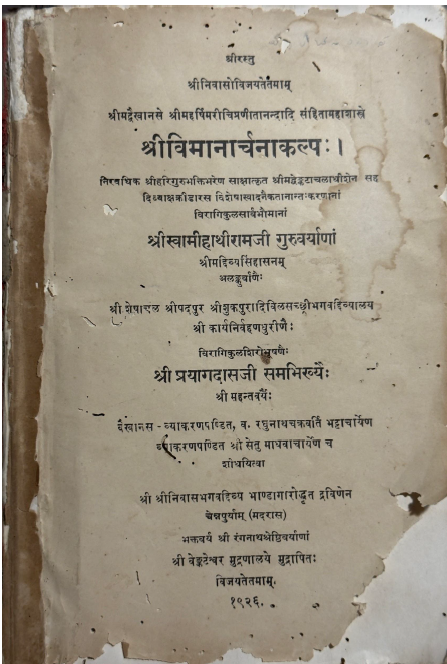
विमानार्चनाकल्पः ४३५–४३६Vimānārcanākalpaḥ, pages 435–436Chapter 70: Ritual Action for Protection against Fear (अथ सप्ततितमः पटलः — भयरक्षार्थ निष्कृतिः)
The passage relied on is from the Vimānārcanākalpa, chapter 70, on the ritual action for protection against fear (bhayarakṣārthaṁ niṣkṛtiḥ), which prescribes what is to be done with the portable deities when a village is thrown into turmoil by thieves, by enemies, or by the fear of invasion. Its direction on the manner of concealment is the operative one:
The printed Vimānārcanākalpa, chapter 70 — bhayarakṣārthaṁ niṣkṛtiḥ, the ritual action for protection against fear.(अथ सप्ततितमः पटलः)(भयरक्षार्थं निष्कृतिः)अथ भयरक्षार्थं निष्कृतिं वक्ष्ये — चोरैः शत्रुभिः परचक्रभयाद्वा ग्रामसंकुले सति भयरक्षार्थं कौतुकस्नपनोत्सवबलिबेरलौहिकप्रतिमानां देवीनां च तिरोधानं कारयेत् ।
Now I shall declare the rite for protection against fear. When a village is thrown into turmoil by thieves, by enemies, or by the fear of an invading power, one should have the portable deities concealed — the kautuka, snapana, utsava and bali images, the metal figures, and the goddesses with them.
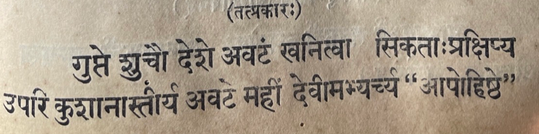
The Method of Concealmenttatprakāraḥ — the manner of it: the pit, the sand, the kuśa grass.(तत्प्रकारः)गुप्ते शुचौ देशे अवटं खनित्वा सिकताः प्रक्षिप्यउपरि कुशानास्तीर्य अवटे महीं देवीमभ्यर्च्य “आपोहिष्ठे”
In a hidden, clean and pure place one should dig a pit, scatter sand into it, and spread kuśa grass over that; and having worshipped the Earth Goddess within the pit, and sprinkled water reciting the three verses beginning āpo hi ṣṭhā…
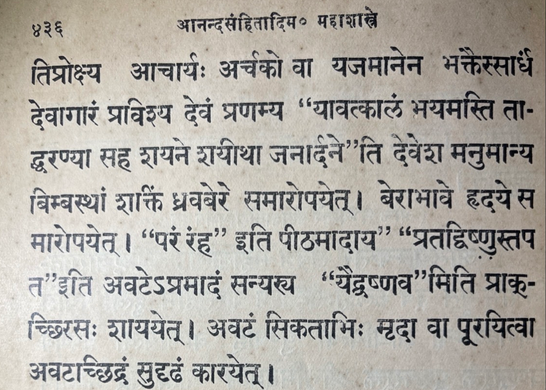
The remainder of the rite: the transfer of the śakti to the fixed image, and the laying of the deities in the pit with their heads to the east.आनन्दसंहितादिम० महाशास्त्रेतिप्रोक्ष्य आचार्यः अर्चको वा यजमानेन भक्तैस्सार्धं देवागारं प्रविश्य देवं प्रणम्य “यावत्कालं भयमस्ति ताद्धरण्या सह शयने शयीथा जनार्दने”ति देवेश मनुमान्य बिम्बस्थां शक्तिं ध्रुवबेरे समारोपयेत् । बेराभावे हृदये स मारोपयेत् । “परं रंह” इति पीठमादाय” “प्रतद्विष्णुस्तपत” इति अवटेऽप्रमादं सन्यस्य “यैद्वष्णव”मिति प्राक्च्छिरसः शाययेत् । अवटं सिकताभिः मृदा वा पूरयित्वा अवटच्छिद्रं सुदृढं कारयेत् ।
[Page 436] From the Ānanda-Saṃhitā and the other great treatises. The ācārya or the arcaka, with the patron and the devotees, should enter the temple, bow to the Lord, and ask his leave in these words: “O Janārdana, for so long as this fear lasts, rest thou in slumber together with thy consorts.”
Having so obtained leave, he should raise the śakti residing in the movable images into the dhruva-bera, the fixed deity; and where there is no fixed image, into his own heart. Reciting paraṁ raṁha, he takes up the pedestal; reciting pra tad viṣṇus tapata, he sets it in the pit without mishap; and reciting yad vaiṣṇavam, he lays the deities down with their heads to the east. Then, having filled the pit with sand, or with earth, he should make its mouth fast.
सिकताः प्रक्षिप्य, having scattered sand, is the whole of the defence, and the closing direction — अवटं सिकताभिः मृदा वा पूरयित्वा, having filled the pit with sand or with earth — says the same thing twice over. The sand lies in the pit by prescription. It is not the soil of the place, and was never meant to match it.
Judicial Scrutiny of the Evidence
The introduction of the Āgamic texts was the turning point of the proceedings, and the judge put the evidence to hard test before admitting it.
The date of publication
The judge asked, pointedly, whether the book being cited had been published recently — about the time of the theft, or about the time of the trial — the implication being that a text produced to fit the case would be worth nothing. Dr. Nagaswamy had to establish that the text had been published long before the dispute arose.
A word-for-word translation
The judge then required a strict word-for-word rendering of the passage relied on. And to secure its accuracy he directed that the translation be furnished to the opposing party well in advance, so that they might set their own experts to check it, word against word, before it was received in evidence at all.
The Metal Analysis
On the scientific side, the tests showed that the several bronzes differed from one another in the composition of their metal. Dr. Nagaswamy explained this from ancient practice rather than from any irregularity: the sculptor did not work to a fixed ratio of metals, but cast from what came to hand, the worn-out copper vessels of the household given up by devotees for the purpose. Uniformity of alloy was never to be looked for.
How the Text Decided the Case
The soil was the other side's strongest ground, and the Āgamic text took it from them. What they offered as proof that these were not the Pattūr bronzes — that the earth clinging to the images was not the earth of the pit — the text turned into corroboration. Sand scattered on the floor of the pit, sand or earth filled in above: on the prescription, a match with the surrounding clay is precisely what should not be found. The objection, once the rite was understood, argued for the other side of the case.
It answered the harder question too. It was asked how a temple in ruins, where no worship had continued for centuries, could be heard to claim its deities at all. The Āgamas contemplate that very condition. The images are not abandoned but put to sleep, by the Lord's own leave, for so long as this fear lasts; the fixed deity holds their śakti in the meanwhile; worship goes on with images of dharba grass. A buried temple, on this reading, is not a dead one. It is a temple waiting.
That the text could carry such weight was owing to the tests it had already survived. Because its date of publication was shown to lie long before the theft, it could not be called a thing got up for the litigation; and because the rendering had been given to the other side in advance, word for word, to be checked by their own experts, its sense could not be disputed at the hearing. It came before the court as an old text, faithfully construed — and so as evidence, not as assertion.
From this, and from the weight of the other evidence, Justice Ian Kennedy held that if even one stone of the temple stands on its site, the temple exists. The Pattūr temple therefore existed in law, and could claim its own; and the Naṭarāja, which had gone from a field near Kumbakōṇam for two hundred rupees and travelled by way of Madras, Bombay and a London dealer, was ordered home to Tamil Nadu.
What was established went beyond the one bronze. A śāstra of ritual prescription had been admitted in an English court, tested as any document is tested, and found to decide a question of title. Dr. Nagaswamy's own concluding thought was that the case might serve as a precedent for the hundreds of Indian bronzes still abroad.
2. "சிலைமீட்ட செம்மல்"
முனைவர் இரா. நாகசாமி அவர்களின் "சொல்மாலை" நூலின் முன்னுரையிலிருந்து ஒரு பகுதி.
குடவாசல் அருகில் பத்தூரில் கிடைத்த நடராஜர் சிலை கடத்தப்பட்டு லண்டன் மாநகரில் அச்சிலை கண்டுபிடிக்கப்பட்ட பிறகு, அதனைத் தமிழகத்திற்கு மீட்டுக் கொண்டு வந்த பெருமை கலைமாமணி நாகசாமி அவர்களையே சாரும். அதன் காரணமாக "சிலைமீட்ட செம்மல்" என்று அவர் அழைக்கப் பெறுகிறார்.
நா. மகாலிங்கம்
3. A Heritage Lecture
Madras Miscellany — The Hindu, Wednesday, Jun 04, 2003S. Muthiah
I'M GLAD to find more and more organisations holding regular heritage lectures and the latest I caught up with was the monthly series being arranged by the Tamil Nadu Department of Archaeology. Its most recent lecture, a fascinating narration of a court case in London that led to the return of a bronze to Tamil Nadu, was by perhaps the Department's best-known Director in recent times, Dr. R. Nagaswamy, whom the London Court had described as being “an unequalled expert in Chola bronzes”. The judge, who knew nothing about Indian art when the trial began but who had become an expert in it by the time the 41-day hearing was completed in 1986 and he, in due course, delivered judgement, was so obviously impressed with Nagaswamy's evidence that one of the grounds of appeal by the defence was the judge being so taken up with Nagaswamy, the witness and interacting with him throughout the trial, asking leading questions and seeking clarifications. Eventually, two appeals were dismissed and the Naṭarāja returned to Tamil Nadu in 1990.
How the Case Began
The case of the peregrinating Naṭarāja began in 1976 when a farmer of Pattūr, near Kumbakōṇam, digging near a temple in ruins, stumbled on ten bronzes, later to be dated to the Cōḻa period. Shrewdly, he offered only one of the pieces, the Naṭarāja, to an itinerant trader and accepted Rs. 200 for it. The trader sold it to an art dealer in Madras for Rs. 10,000 and the art dealer sold it in Bombay for Rs. 2 lakh, after which the Naṭarāja was lost from sight. In 1982, Scotland Yard received a tip that a Naṭarāja was being privately cleaned by an employee of the British Museum — and the investigation that followed led to the case that Dr. Nagaswamy, forensic scientist Dr. Chandrasekhar and IGP Rajasekharan Nair played key roles in London.
The Evidence in Court
The three who had sold the Naṭarāja by turn narrated their transactions, the scientists reported the results of metal tests, soil tests and termite tests, which, overall, indicated that the London Naṭarāja MIGHT indeed have laid buried in the ground where it was found but were inconclusive, and then Nagaswamy offered four days of evidence and spent a fifth day on the stand being cross-examined. Offering evidence on the inscriptions and dating it to the Cōḻa period, he also spoke of its styling and demonstrated that it was distinctively Cōḻa. Then, citing the Āgamas, he described how, when a temple was threatened by invaders, its deities should be buried in a particular manner, on a bed of river shore sand, and worship continued with ikons made of dharba grass. When he was asked how a temple in ruins and where no worship continued could lay claim to its deities, his Āgamaic citations led to the judge concluding that if even one stone of the temple exists on its site, the temple exists. And so the Naṭarāja, from this and the weight of the other evidence, he ruled, belonged to the Pattūr Temple.
This brief summary does no justice to Nagaswamy's gripping narration — accompanied by slides of some of the most beautiful Cōḻa bronzes I have ever seen — and I hope he one day tells it all exactly as the case unfolded. Meanwhile, we can only regret with him the sad fate that awaited the Pattūr bronzes when they were returned to Tamil Nadu.
What Became of the Bronzes
The Tamil Nadu Archaeological Department has lined up and marked all the stones of the old temple for restoration. They had also excavated and found the remains of the temple wall that clearly showed the treasure had indeed been buried in the temple precincts. Only the bronzes were awaited. But soon after they arrived with great fanfare, everything on the site of the temple was bulldozed and a brick and mortar temple raised to house the deities! With no stone of the old temple in the new, I wonder what that makes of the judge's ruling on title. Be that as it may, Nagaswamy's concluding remarks, that this case could be used as a precedent to reclaim through the courts hundreds of India's bronzes abroad, make me wonder. Those in public museums abroad are very likely better off than here. But those in private collections, no matter how well tended, deserve to be seen by a wider audience. Would citing this case `smoke' them out and into museums is a thought to dwell on.
S. MUTHIAH
4. Man Who Brought Nack Nataraja
Originally published in Times of India on 25th, January 2022
by K.R.A. Narasaiah.
Arguing for the return of a Nataraja idol from a private collector, India presented evidence to prove it was smuggled out of Tamil Nadu, but the turning point happened when archaeologist Ramachandran Nagaswamy was called to provide evidence in a special court in London. After presenting his case for four days and being cross-examined for the fifth, when Nagaswamy stepped down from the stand, it was clear that the Chola bronze would return to its homeland.
The Government retained the forensic expert Pakkiriswamy Chandra Sekharan and archaeologist Nagaswamy who stood out as the most important person to prove the case. Over five days of proceedings, Nagaswamy proved that the styling of the bronze was distinctively of Chola vintage. Citing the Agamas, he described how when a temple was threatened by invaders, its deities should be buried in a particular manner. When he was asked how a temple in ruins and where no worship continued could lay claim to its deities, his agama citations led to the judge concluding that if even one stone of the temple exists on its site, the temple exists. Sivakami won the case.