Balarāma, the brother of Kṛṣṇa, was an influential god in early centuries of the current era, His sculptural representations are found in many places of India as at Nagarajunakonda in early period. He is shown generally with a drinking cup and standing by the side of his sister and brother Kṛṣṇa. He is also said to be given to drink and pleasures (Bhōga)
Balarāma and Kṛṣṇa
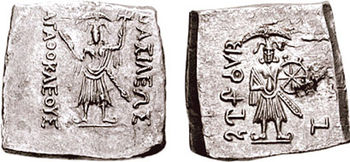
Balarāma in a Bactrian coin
Obverse: Balarāma, with Greek legends on either side :
Reverse: Kriṣhṇa with Brāhmi legend; the conch is held vertically: courtesy Wikipedia
Balarāma is shown in a square silver coin (a standard drachma) issued by the Bactrian King Agathocles (c.180 BC) portrayed Kriṣhṇa and Balarāma that was excavated Ai-Khamun, an important archaeological site on the Oxus (ref. Arts Asiatique XXXVI ( 1973), 52-57 and Journal of the Numismatic Society of India XXXV (1973) , 1873-77. I am thankful to Prof Ḍevendra Handa for this reference). On this coin, square in shape the obverse of this coin, shows Balarāma standing with two hands holding a (hala) plough and (musala) pestle (mace). The pestle may be identified with the dhyānaśloka of Balarāma who is interestingly called Kāmapāla i.e., protector of love or desires.
sphurad-amala-kirīṭam kiṇkiṇī-kaṅkaṇārham calad-alaka-kapōlam kuṇḍala-śrī-mukhābjamtuhina-giri-manōjñam nīla-meghāmbarāḍhyam hala-musala-viśālam kāma-pālam samīḍhe
By the side is written the name of the king “Basiles Agatokleus” in greek characters while on the reverse is shown Kṛṣṇa also standing with two arms holding a wheel and a conch. The wheel is so big it seems to do justice to the name Rathāngapāṇi. The Wikipedia, which illustrates this coin, identifed the object in the right hand of Kṛṣṇa as kamaṇḍalu (Vase) but in fact it represents a conch held vertically in hand (śankha).
images/krishna_script.jpg
By the side of Kṛṣṇa on both the sides is the name of the king written in perfect Brāhmi script in Prākṛt reading “Rajñe Agathuklayeṣa”.
The first letter “ra” is in serpentine form. Whether there is a second letter is not very clear for it merges with the big cakra held in the hand of Kṛṣṇa. The next letter is “ne”. so the actual reading is “rane”. These letters are seen to the left of Kṛṣṇa while on to his right is the name of the king “agathuklayeṣha”. This type of bilingual coins were also issued by Sātavāhana kings of Andradesa, where on one side we have the title for example rajno vaciṭṭiputaso siri satakanisa. (In Sātavāhana coins the word King is mentioned as rajno obviously the Prākṛt form)
Both the images of Kṛṣṇa and Balarāma are in greek attire. Kṛṣṇa wearing a long sword and Balarāma an unidentified handled weapon (probably a ring with twisted rope), tucked in their waist band. They also wear a crown which is not the conical Indian crown, but the Bactrian crown, with two horn like projections on either side and a jeweled umbrella over his head resembling a horizontal cap. Both are also seen wearing shoes. But what is important is that the figure of Balarāma is shown on the obverse where the Greek name occurs and the figure of Kṛṣṇa occurs on the reverse. It seems to emphasize the importance of Balarāma as the elder as it appears on the side of the issuer and depicts his prowess while Kṛṣṇa with his conch signifies “spreading fame”. The conch is that which blows the fame of Kṛṣṇa through out the world. The choice of the two figures also seem to show the Bactrian kings made this choice of Balarāma and Kṛiṣhṇa to exhibit their strength (by Balarāma) and fame (by Kṛṣṇa) on their coins. Evidently the legends of Kṛṣṇa and Balarāma and also their special characteristics have become so popular before 2nd cent BCE even in Bactria to be use there in their coins.
A Sangam Tamil poem of the beginning of the CE extols four great deities Balarama, Kṛṣṇa and Rudra and Subrahmaṇya for their praiseworthy achievements as strength, fame, furious attack on enemies, and determination to fulfill his undertaking respectively. Balarāma is referred to as Vāliyōn (Vali – bala in Skt). He is also called Veḷḷai nāgan, the white serpent. It has also been suggested earlier that the depiction of the two gods, Balarāma and Kṛṣṇa was to exhibit the religious leanings of the issuing king. Evidently the legends of Kṛṣṇa and Balarāma and also their special characteristics have become so popular before the 2rd cent BC even in Bactria in the region of the River Oxus, beyond Afganisthan to be imprinted there in their coins.
January 31, 2007