The Great Śaiva saint Appar who lived in the 7th cent, sings the praises of Śiva in one of his Tēvāram hymns in the following lines.
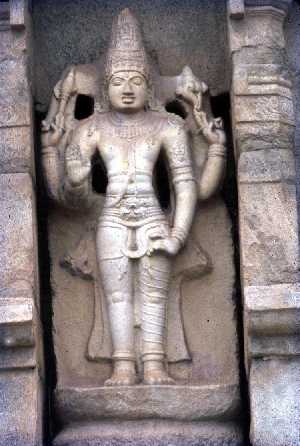
tīk-kūrnta tirumeṉi orupāl maṟṟai oru pālum ari-uruvam tikaḻnta celvarHari-Hara Gaṅgai Koṇḍa Choḻapuram
It refers to the composite form of Śiva known as Hari-Hara or Śaṅkara Nārāyaṇa in which form Śiva’s right half is red like fire and the left half is Green. In fact it also means that the right half of Śiva is Rudra and the left half is of Viṣṇu. Such a composite imagery was created by the Vedic seers of India around 1500 BCE.
There is an invocation in the Vedas, (repeated many times), addressed to a dual deity called Agna-Viṣṇu. A question is raised in the Veda itself who is this Dual deity; which prayer is addressed to whom and what is the result? Veda answers:— the Dual form is that of Rudra and Viṣṇu combined in one, for Rudra is none other than Agni — Fire. Viṣṇu is also fire (shining). The Fire has heat energy and light energy. When the emission of heat is referred to, it is called Rudra and when light is emitted it is called Viṣṇu (i.e shine) Both powers inhere in the same fire. Agni is called Rudra. “rudro vā eṣa yad agniḥ”
Viṣṇu means to shine or illuminate
When the invocation is addressed to the function of heat He is called Agni — Rudra and when the lighting function is addressed it is called Viṣṇu. One of the power, the heat is terrible - “ghora” - while the light energy is welcome cool. The terrific aspect is addressed as “ghora” in masculine gender and the cool light energy is addressed in femenine gender as Śivā. “ghora anya śivā anya". One is Śiva and the other is Śivā.
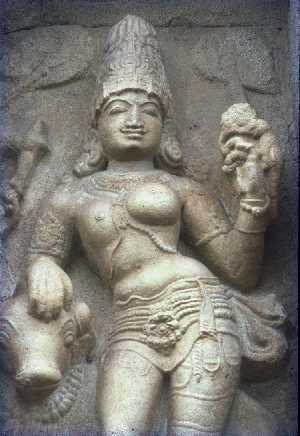
Ardhanārīśvra Gaṅgai Koṇḍa Choḻapuram
This also gives rise to the dual form of masculine and femenine combined in the same fire. When the Vedic rishis sought to give an imagery for this dual inherent functions of Agni — fire they visualized the Agna-Viṣṇu image, the roots of Hari-Hara and Ardhanārīśvra forms. The Veda says Satarudra hymn should be addressed to Agni-Rudra by which the heat is cooled. A hymn called “Vasordhara” is to be recited for the Light - Śivā form and by this the devotee pleases the Deity. Both the forms Hari-Hara and Ardhanārī are considered curious by modern scholars and interpreted wildly, are but the poetic imagery created by the Vedic seers for two inherent natures of Fire, Agni-Rudra.
It is from heat (Agni-Rudra) all beings come into existence, by heat all beings are sustained (living organism dies the moment heat disappears) and dissolves into heat at the end. So the Śaivites tell us that Rudra-Śiva is the Creator, Sustainer and Annihilator of this Universe.
For thousands of years, this powerful imagery has given rise to exquisite sculptures of composite forms of Hari-Hara and Ardhanārīśvara, as the two sculptures illustrated here.
This is what Appar sings in the 7th cent. Tēvāram hymn.
Text and photos by Dr. R. Nagaswamy, Madras