|
Millenium Special Edition
Issue Date: 01-Jan-2000
Dedication:-
This Journal is dedicated to the memory of Parvathi Nagaswamy who stepped into heaven at the age of 60 on Aug 22nd 1999. Parvathi was a keen student of Sanskrit and Tamil literature and was a talented musician. She was deeply devoted to Tēvāram, Divya Prabhandam, Thirupukaḻ, Lalitha Sahasranāmam, Thyāgarāja’s kīrtanas and other classical compositions.
Introduction:-
At the start of 2nd millenium, over thousand years ago, the entire Southern part of India witnessed the rule of an all round genius Rājarāja Chōḻa I (985 to 1015 CE). In the fields of arts, architecture, sculpture, paintings, bronzes, music and dance, literature, war and peace, administration and justice, religion and philosophy, catholicity of outlook and above all clarity of thought and implementation, Rājarāja was an unequalled monarch. He paid meticulous attention to the welfare and comfort of his people. Thousands of his inscriptions that have survived give vivid picture of his personality and contributions.
The Festival of Dancing Siva:-
A festival, mentioned in one of the temple digests of Tamiḻnāṭu, seems to indicate a connection between the concept of Kālāmukha and the image of Naṭarāja. The image of Nṛttamūrti with his consort is brought to the Āsthāna maṇḍapa, i.e., audience hall of the temple on the 8th day of the festival. In the latter half of the night, rakṣā (protective thread), is fastened to the images of Naṭarāja and Śivakāmi which are then decorated with beautiful garments, jewels and flower garlands before being taken out in procession around the temple and finally placed in the maṇḍapa.
Hari-Hara:-
The Great Śaiva saint Appar who lived in the 7th century, sings the praises of Śiva in one of his Tēvāram hymns. It refers to the composite form of Śiva known as Hari-Hara or Śaṅkara Nārāyaṇa, in which Śiva’s right half is red like fire and the left half is green. This powerful imagery has given rise to exquisite sculptures of composite forms of Hari-Hara and Ardhanārīśvara."
Kadambur:-
Kadambur is now a small village about twenty-five kilometers from Chidambaram. It is an ancient village going back to the 6th century or even earlier. The present village is in two parts: the Western village, Melak-kadambur, and the Eastern village, Kilakkadambur. The Siva temple now located in Melak-kadambur is identical with Thiruk Karakkoyil sung by the Nayanmars. It is a unique structure in which the main temple vimana is in the form of a wheeled chariot – the celestial ratha – drawn by horses.
Kartikai and Gospel:-
The Kṛttikai (Kārtikai) festival is a very important day for the Hindus, for it symbolizes the summum bonum of Hindu philosophy. It is the Day Lord Śiva manifests as the Pillar of Effulgent light the Liṅgodbhava. Viṣṇu and Brahma tried to trace the origin and end, one going to the nether world and the other to heaven to see Śiva's feet and head. Both failed. Śiva's appearance as a Jyotir Liṅga is celebrated in Thiruvannamalai (in fact in all temples) by placing the jyoti and also the bonfire. Jñānasambandar addresses Pūmpāvai in his Mylapore Tēvāram exhorting her to witness the Kārtikai festival. (Sambandar mentions all the “māsotsavas” — Monthly festivals in this hymn, attesting to the Āgamic prescriptions.)
Pasupati in an Egyptian Papyrus:-
The Supreme Lord Śiva is called Paśupati in the Vedas. An ancient Middle Eastern text calls the Supreme Lord The Shepherd man. Śiva wears the moon on his head, symbolizing knowledge according to the Śaiva āgamas. The moon is extolled as the presiding deity of knowledge and was called Thot in Ancient Egyptian religion. This concept was also adopted in Greek mythology, where the deity of knowledge was called Hermes.
Kalinga influence on Tamil Literature:-
Kulōttuṅga I was a great Cōḻa monarch who ruled for 55 years from 1070 to 1125 CE. He was the grandson of Rājendra Cōḻa, through his daughter. On his father's side, he was the son of Rājarāja Narendra, the Eastern Chalukya king. Rājendra Cōḻa won great victories over the Palas of Bengal and assumed the title of Gangai-Koṇṭa-Cōḻa. Kulōttuṅga had similar ambitions.
Kalinga Saved:-
The recent cyclone that hit the Orissan coast, the worst in this century, devastated a large tract of the ancient Kalinga kingdom, killing more than 9000 people and over 40,000 cattle. Even after fifteen days, the government was struggling to clear the human corpses, not to speak of cattle. The velocity of the cyclone was staggering, leaving behind unimaginable human suffering. As you are aware, the ancient Kalinga, particularly the coastal regions, has a very large number of temples, most of them ranging from the 7th to 12th centuries. They are architectural masterpieces carrying exquisite sculptures representing various deities, portraits, dancers, animals, and floral designs. The group of temples and their sculptures are the standing witness to the Kalinga religious ethos and art.
A 16th Century Bronze image of Rati:-
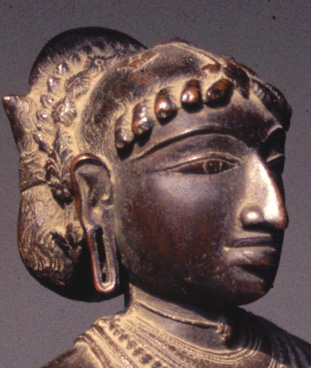
This bronze image is in the collection of Sarabai Museum, Ahamedabad. Whom does it represent? A large number of halls (maṇḍapās) were built in the temple premises during the Vijayanagar period. Among many sculptures prominently portrayed on the pillars are the images of Manmatha and his beautiful wife Rati. Manmatha is shown riding on a leogrif and holding a sugar cane bow, while Rati is portrayed on a parrot also holding a bow and arrow.
Service Tenure of Judges:-
Recently some of the Judges of the High court were transferred from one place to another. This attracted the attention of the public from different angles. The transfers were effected, according to the authorities, to maintain the highest standards of the judiciary and improve its efficiency. Others questioned this stand and imputed motive. Even one of the judges expressed his disappointment over the transfers.
|