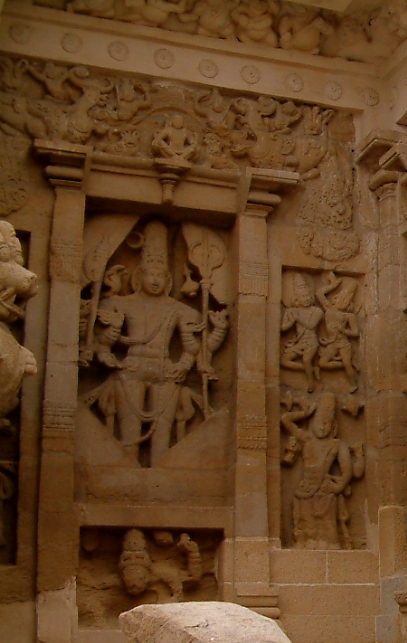
Liṅgodbhava, Kailāsanātha Temple, Kāñci
The Kṛttikai (Kārtikai) festival is a very important day for the Hindus, for it symbolizes the summum bonum of Hindu philosophy. It is the Day Lord Śiva manifests as the Pillar of Effulgent light the Liṅgodbhava. Viṣṇu and Brahma tried to trace the origin and end, one going to the nether world and the other to heaven to see Śiva's feet and head. Both failed. Śiva's appearance as a Jyotir Liṅga is celebrated in Thiruvannamalai (in fact in all temples) by placing the jyoti and also the bonfire. Jñānasambandar addresses Pūmpāvai in his Mylapore Tēvāram exhorting her to witness the Kārtikai festival. (Sambandar mentions all the “māsotsavas” — Monthly festivals in this hymn, attesting to the Āgamic prescriptions.)
vaḷaikkai maṭanallār mā mayilai vaṇ maṟukil tuḷakku il kapālīccurattāṉ tolkārttikaināḷtaḷattu ēntu iḷamulaiyār taiyalār koṇṭāṭumviḷakkīṭu kāṇātē pōtiyō? pūmpāvāy! — 2.47.3
The festival of light is mentioned very much earlier in the Saṅgam literature.
Appar has an ennobling poetry on the concept of Liṅgodbhava in his famous poem “talaiye nī vanaṅgāy”. This Tevaram is called aṅgamālai, i.e garland of limbs. After addressing each and every limb of the body to adore Lord Śiva, Appar sums up the ultimate truth of Śaivism in the concluding verse.
tēṭik kaṇṭu koṇṭēṉ! tirumāloṭu nāṉmukaṉumtēṭit tēṭa oṇāt tēvaṉai, eṉ uḷē, tēṭik kaṇṭu koṇṭēṉ! — 4.9.12
Appar sings and dances in ecstasy saying I have seen the Lord whom Brahma and Viṣṇu could not see even after of great search. Appar has seen the Lord within his own self — “en uḷē”.
There are two important points worthy of note in this legend. First Brahma and Viṣṇu were puffed up with pride thinking there was none superior to them. This impurity of egoism (āṇava mala) concealed their true self that they are also part of that effulgent light. The second point — they directed their search externally, one going up and the other down, while all the time the Supreme Śiva was their own self as Conscious — Light. This is the subject matter of all the Purāṇās, particularly the Liṅga-Purāṇā which emphasizes the Supreme nature of Lord as effulgent Light — Ones own consciousness that dispels ignorance. Appar refers to “Liṅga-Purāṇā” —
“iliṅga purāṇattu uḷāṉai”.
aripiramar toḻutu ēttum attaṉtaṉṉai antakaṉukku antakaṉai, aḷakkalākāeri puriyum iliṅkapurāṇattu uḷāṉai, eṇ ākip paṇ ār eḻuttu āṉāṉaitiripuram ceṟṟu oru mūvarkku aruḷceytāṉai cilantikkum aracu aḷitta celvaṉtaṉṉainari viravu kāṭṭu akattil āṭalāṉai; nāraiyūr naṉ nakaril kaṇṭēṉ, nāṉē — 6.74.8The Egyptian Gospel
This concept was also the fundamental concept of God in Christianity in its early period. There is a text called Egyptian Gospel composed around the first half of the 4th Century CE. The text is written in Coptic and is said to be a copy of a original Greek version dated to be much earlier. I give below a few points from that text which speaks about the nature of God.
“The light of fullness. The Eternal light of the Aeons. The Light in silence. The Light in word and truth. The Light of the incorruptabilities. The inaccessible light. The Light that has emanated for ever. Traceless, ineffable and unproclaimable.”
There are many more. These statements could be studied in grearter detail. But please note that God was visualized as “Inaccessible Light”, like Liṅgodbhava whose origin or end could not be fathomed. God, according to early Christianity is unproclaimable. According to Hindu concept neither the word nor the mind can reach God and He is indescribable “yato vaco nivartante aprāpya manasā saha” says the Vedas. The Early Christians believed that God is “Eternal Light”.
The Hindus call God as Eternal Light “param jyotiḥ”. The Śiva Liṅga inside the sanctum of temples, that is the principal object of worship is a symbol of that “Eternal Light”. The Early Christians considered God as “The Light in Word and Truth”. “The articulated sound and words were created for the illumiantion of the world” says the Śaiva Āgamas. The Śaivite and Vaiṣṇavite saints sing of God as words and their meanings “collanai porulanai”. Think of Appar's poem
ariyāṉai, antaṇartam cintaiyāṉai, arumaṟaiyiṉ akattāṉai, aṇuvai, yārkkumteriyāta tattuvaṉai, tēṉai, pālai, tikaḻ oḷiyai, tēvarkaḷtam kōṉai, maṟṟaikkariyāṉai, nāṉmukaṉai, kaṉalai, kāṟṟai kaṉaikaṭalai, kulavaraiyai, kalantu niṉṟaperiyāṉai, perumpaṟṟappuliyūrāṉai pēcāta nāḷ ellām piṟavā nāḷē — 6.1.1
All Religions have proclaimed the nature of God in identical terms. A deeper study would reveal there is no fundamental difference between religons. The divisions are man made in an effort to comprehend the incomprehensible. The true religious follower can and will, have no hatred or disbelief towards any religion.
That is what is said by the Vedas “Truth is One: the learned call it by different names”.
“ekam sat vipra bahudhā vadanti”.
Nagaswamy R ;
23-Nov-1999