Tamil Arts Academy (Volume 34)Issue Date: 10-Aug-2026Transactions of the Archaeological Society of South India, 1959–602. New Bronze Finds from TiruveṇkāḍuR. Nagaswamy1960-12-12
Emblem and Motto
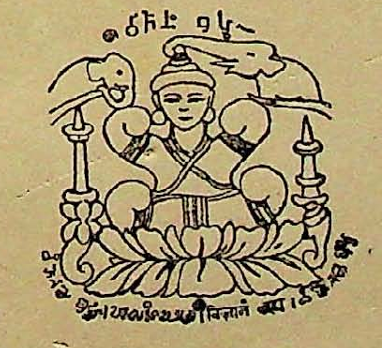
The wealth, both material and cultural, of the past, from which has arisen the wealth of the present and from which will grow the wealth of the future, is the subject-matter of archaeology. The wealth of the three kālas is symbolised as Śrī, seated on Purity, the lotus, which rises from Plenty, the waters, and in the midst of the Hordes of Substances, the nidhis, the Treasures, which, though symbolically nine, are usually mentioned, for clarity, as two, the śaṅkha (Conch) and the padma (Lotus) nidhis — shone upon by the Light given off by the Substances and lustrated by elephants who are the Showerers of the wealth of the quarters. She causes wealth to be attained to by effort, without any giving by Her and without any coming by Her to give, She lacking feet that could walk and hands that could give.
vijñānam brahmaKnowledge is Truth
The ancient injunction is: meditate on knowledge obtained from special enquiry, for it is truth. The Archaeologist, in his specialised ways, seeks Knowledge for Truth.
The sketch copies a sculptured piece of about the 9th century A.D., from Kāvēripākkam, near Kāñcīpuram. The motto, which is taken from the Taittirīya Upaniṣad, being in Saṃskṛta, is also rendered in the representative languages of the South, and is written in the most ancient characters used for the several languages, as well.
Members of the Executive Council of the Archaeological Society of South India, 1959–60PresidentSri Justice A. S. P. Ayyar, M.A., I.C.S., F.R.S.L., Bar-at-Law, Judge, High Court of Judicature, Madras (Retd.), Director of Legal Studies, Madras Government.Vice-PresidentsProf. K. A. Nilakanta Sastri, M.A., Professor of Indian History and Archaeology (Retd.), University of Madras.Sri K. R. Venkatarama Iyer, Director of Public Instruction (Retd.), Pudukottah State.Executive CouncilDr. J. T. Cornelius, 2, R. S. V. N. Road, Madras-10.Dr. K. K. Pillay, Professor of Indian History and Archaeology, University of Madras.Dr. V. Raghavan, Professor of Sanskrit, University of Madras.Sri K. R. Srinivasan, M.A., Superintendent, Department of Archaeology, Temple Survey Project (South), Madras.Dr. N. Venkataramanayya, Reader in Indian History and Archaeology (Retd.), University of Madras.Hon. SecretarySri R. Nagaswamy, M.A., Curator, Archaeological Section, Government Museum, Madras.Hon. TreasurerDr. T. V. Mahalingam, Professor of Archaeology, University of Madras.Preface
This, the fifth volume of the Transactions, continues the task of unravelling the mysteries of the past, the unearthing of monuments, epigraphs and statues, the deciphering of scripts, and the exposition of the various patterns of Art and Architecture throughout the twelve regions of our vast country. There is no land on earth so full of cultures and monuments like India, which is a regular paradise for archaeologists and historians, and is, unlike Assyria, Sumeria and Babylonia, not dead but very much alive and still progressing.
Though one uncharitable foreign critic said, some years ago, “Mother India is fallen, She can never rise again; She is cast down for ever. None on earth can raise her up”, his gloomy prophecy has been falsified. India was old when England was young, and she is young when England is old. We are going to have the centenary celebrations of the Archaeological Survey of India towards the close of this year, inviting the representatives of many other nations. We are also taking an active part in World Affairs. So it cannot be said that we are only the dead remains of a dead Past.
It behoves us not to ignore the Past or the Future, but to realise that our Present is the child of the Past, and our Future the child of the Present. No old thought or concept really dies. It reappears in a new and better form. As John Masefield has said,
I hold that when a person dies,His soul returns again to earth,Arrayed in some new flesh disguise.Another mother gives him birth;With sturdier limbs and brighter brain,The old soul takes the road again.
Thus we find the ideas of the Puṣpaka Vimāna and Space travel, of deadly nuclear weapons killing crores at a time, of the emergence and submergence of whole worlds, referred to in the Purāṇas and depicted so vividly in our sculptures and paintings, recurring in modern times in more vivid forms.
Our Society has been carrying on for the last 26 years with practically no funds, levying a nominal subscription of three rupees per year, often left in arrears, the Transactions being printed for the last five years with a grant from the Madras Government. Our real treasure consists in the unfailing enthusiasm and energy of our members and friends, and their indefatigable zeal in the cause of India's Past with a view to serve India's Future.
The present volume begins with an interesting paper read by Professor M. M. Bhat on “Kannaḍa Literature through Inscriptions”, beginning with the Palmiḍi inscription of 450 A.D. in Pūrvada Haḷagannaḍa, and going on to later inscriptions in Haḷagannaḍa and Naḍugannaḍa and Hosagannaḍa. Mr. Bhat deals critically with these inscriptions and their dates, like a modern historian. A sober scholar, he does not revel in millenia. We get next, an excellent paper read by Dr. T. V. Mahalingam, Professor of Archaeology of the University of Madras, on the Mallam Inscription of Nandippōttaraśar, of the 8th century A.D., in his usual clear, lucid and impressive style.
We come next to the brilliant paper on the Evolution of Iconographic Concepts, Hindu, Jain, and Buddhist, by Mr. P. R. Srinivasan. It is well known that India is famous for such images, both in number, size and artistic beauty, sometimes foreigners also contributing to it, as in the case of the Gandhāra Buddhas. One has to reflect a little before realising the depth of the beauty of these images. Thus, a Chōḻa Naṭarāja bronze of the 11th century A.D. shows Statistics in Dynamics, Dynamics in Statistics, Motion in Repose, and Repose in Motion, and combines this world and the next in one marvellous sweep of curves. The serenity of the Buddha image of Gandhāra or Sāñcī is unsurpassed. The group of images comprising Rāma, Sītā, Lakṣmaṇa and Hanumān makes an unforgettable impression on us. So, too, Kṛṣṇa playing on the flute, shows the sport of Life and Death, and the mystery and continuity of existence. Likewise, the images of Umā and Maheśvara, and Rādhā and Kṛṣṇa.
Last in the volume, but not the least, is a fascinating paper on New Bronze Finds from Tiruveṇkāḍu by our present Secretary, Sri R. Nagaswamy, the Curator of the Madras Museum. His exposition of the Ardhanārīśvara image is deep and penetrating and helps to bring out its full meaning. His interpretation of the Naṭarāja image is equally interesting though somewhat different from Mr. Srinivasan's.
There is an article on Literary and Ethnographic references to the Tāli and Tāli Rite, contributed by Mr. C. J. Jayadev. It shows how the Tāli, as the sole marriage ornament, took a thousand years of culture to establish itself in South India, not being known at the time of the marriage of Kōvalan and Kaṇṇaki in the second century A.D., when the Vedic Rite of the Saptapadī, which still continues, was the main ritual. Dr. M. Rama Rao has contributed an interesting article on the Chāḷukyan temples of Satyavōlu in Kurnool district. Messrs. Krishnamurthi and Gururaja Rao, Lecturers in Archaeology in the University of Madras, have dealt with the progress of Archaeology from 1956–57, till which year it has been summarised in a previous volume, and brought it up-to-date in all its aspects of unravelling Palaeolithic, Neolithic, Microlithic, Chalcolithic, and Megalithic Cultures, as also historical monuments, sculptures, coins etc. Then there is an article on “Pāṇḍya Genealogy and Śrī Nammāḻvār” by Pandit Raghava Ayyangar, rendered into English by his son, Sri Narayana Ayyangar, and interpreted by Sri Aravamuthan.
We had, in addition, lectures by Sri Bannerjee, Superintendent, Excavation Branch, on Excavations at Ujjain, by Mr. William Willets on “Historical connection between China and Ceylon”, by Sri B. B. Lal, Director of School of Archaeology, New Delhi, on “Excavations at Kālibaṅgan”, a third major site of the Harappā Civilization recently discovered in Rājasthān, and by Professor Gebhard on “American Archaeology”, a subject not so widely known here till recently. These lectures, it is hoped, will appear in a future volume of the Transactions, and will be of profound interest. Sri Lal, for instance, showed that the writing in the inscriptions at Kālibaṅgan was from right to left, which, if correct, will furnish a key to the unravelling of the hitherto undeciphered Indus Valley Inscriptions.
I am sure that the readers will agree that this volume does not fall behind its predecessors in quality and interest and wealth of illustrations. In conclusion, I thank the Government of Madras for their generous grant, all the speakers and contributors for their speeches and papers, the members for their hearty co-operation and increased attendance at meetings; the editorial sub-committee for the …
New Bronze Finds from Tiruveṇkāḍu*R. NagaswamyCurator for Art & Archaeology, Government Museum, Madras
The presiding deity of Tiruveṇkāḍu, who has the bull as his banner, is praised by the two great saints of Śaivism, namely, Tirunāvukkarasu, familiarly known as Appar, and his younger contemporary, Tirujñānasambandar, in almost identical verses, which incidentally begin with an address to Lord Śiva as Ardhanārīśvara.
கண்காட்டு நுதலாலுங் கனல் காட்டுங் கையானும்பெண்காட்டு முருவாலும் பிறைகாட்டுஞ் சடையானும்பண்காட்டு மிசையானும் பயிர்காட்டும் புயலானும்வெண்காட்டில் உறைவானும் விடைகாட்டுங் கொடியோனே.(சம்பந்தர்)கண்காட்டிப் படியாய தன்பத்தர்க்குக் கண்காட்டிகண்ணில் நின்ற மணியொக்கும் பெண்காட்டிப்பிறைச் சென்னிவைத்தான திருவெண்காட்டையடைந்து உயம்மட நெஞ்சமே.(அப்பர்)
This conception of Ardhanārīśvara in the form of an elegant bronze was unearthed in the same village with a group of other bronzes and is now housed in the Madras Museum, which is verily a treasure house of bronzes. The addition of this figure to the collection has enriched the Madras Museum to a very considerable degree and provides an opportunity for the art connoisseur to study the best pieces of South Indian Art under one roof, for this figure is so exquisitely modelled and delicately finished that it rightly deserves a place in the list of such master pieces as Tiruvālaṅkāḍu Naṭēśa, Rāma group from Vaḍakkupaṇaiyūr and other bronzes.
The Bhagavadgītā, in most emphatic terms, declares that Puruṣa and Prakṛti are eternal, without any beginning; none could have preceded or succeeded the other.
प्रकृतिं पुरुषं चैव विद्ध्यनादी उभावपि ।— भगवद्गीता १३-१९
Only when the primordial matter and energy, Puruṣa and Prakṛti, unite into one, there is creation. The Puruṣa is called Māyin and the Prakṛti is called Māyā, says the Śvetāśvatara Upaniṣad.
मायां तु प्रकृतिं विद्यान्मायिनं तु महेश्वरम् ।तस्यावयवभूतैस्तु व्याप्तं सर्वमिदं जगत् ॥— श्वेताश्वतरोपनिषद् ४-१०
When this Puruṣa and Prakṛti of the Sāṃkhyas, the Brahman and Māyā of the Vedāntins, Śiva and Śakti of the Śaivas, Yōgēśvara and Yōgamāyā of the Gītā, are inseparably united, the cosmos vibrates. The Śivapurāṇa states that Brahmā begot Prajāpatis and entrusted them with the creation of other beings, which they were unable to fulfil. Brahmā resorted to do penance towards Śiva, and on seeing Śiva, who appeared before him as Ardhanārīśvara, Brahmā realised his mistake of having forgotten the Śakti aspect, and sought the blessings of Śiva.
The other story is that of Bhṛṅgi, a sage, who, as a great devotee of Śiva, refused to pay obeisance to Pārvatī. Pārvatī was rather disturbed and became united with Śiva as Ardhanārī and offered difficulty to Bhṛṅgi in worshipping Śiva alone. But the sage took the form of a beetle, pierced a hole in the composite form of Śiva and circumambulated Śiva alone, and this undisturbed devotion reconciled Pārvatī, who blessed him. Kālidāsa's invocatory verse in the Raghuvaṃśa and Māṇikkavāsagar's lyrical composition addressed to Ardhanārīśvara too deserve mention here.
वागर्थाविव संपृक्तौ वागर्थप्रतिपत्तये ।जगतः पितरौ वन्दे पार्वतीपरमेश्वरौ ॥— रघुवंश - मङ्गलस्तुतिதோலுங் குழையுஞ் சுருள் தோடும்பால் வெள்ளை நீரும் பசுஞ்சாந்தும் பைங்கிளியும்சூலமும் தொக்கவளையுமுடைத் தொன்மைக்கோலமே நோக்கிக் குளிர்ந்தூதாய் கோத்தும்பி.(மாணிக்கவாசகர்)
It will be of great interest if the few well known sculptures of Ardhanārīśvara are mentioned here, before proceeding to treat this particular bronze. According to the Āgamas, the figure of Ardhanārīśvara may have two, three or four arms.
The panel from the Bādāmi Cave1 representing this theme is four armed, holding a paraśu and nīlōtpala on the upper pair, while the lower pair holds a vīṇā and plays upon it. The vṛṣabha is seen on the back right of this figure. Bhṛṅgi is represented as an emaciated person. Except this and the unusual seated figures of Rājasiṃha Pallava's period, we do not come across vīṇā being associated with Ardhanārīśvara. Slightly later in point of time is the Ardhanārīśvara panel of Elephanta2, which is also four armed, but does not hold a vīṇā. The upper pair of arms holds a ṭaṅka and a mirror while the lower right rests on vṛṣabha. The panel is broken below the waist, with the result that no idea could be formed of the position of the legs. But the figure of Elephanta is much more evolved and graceful than the Bādāmi figure.3
Another and perhaps the earliest representation from South India is the slim and elegant figure4 sculptured at the Eastern face of the Dharmarājaratha at Māmallapuram, holding with its upper pair of arms a paraśu and flower. The lower pair is in abhaya and lōla hasta poses. The vehicle of Śiva, which is the bull, is conspicuous by its absence.
The most graceful and elegant sculpture is from the Nāgēśvara temple at Kumbhakōṇam5, which is three armed. The lower right hand rests on the vṛṣabha while the upper holds a paraśu, and the only left hand holds a mirror. Another graceful and similar figure is from Tiruvāṇḍārkōil near Pondicherry6, which is almost identical with the Kumbhakōṇam sculpture, except in one aspect, that it holds a nīlōtpala in place of a mirror in its left arm. The Ardhanārīśvara from Dārāsuram7 is quite unusual, for it has three heads and eight arms. All the above mentioned sculptures have the female half on their left side as enjoined in the Āgamas, while in the figure from Tiruvaḍi near Tanjore8, the female half is represented on the right side.
Very few bronze figures of Ardhanārīśvara have been reported so far. The bronze figure from Tiruccheṅkōḍu is a comparatively modern bronze with two arms, holding a stick in its right arm and resting its left in kaṭyavalambita posture. The hair is peculiarly treated and the bronze has all the rigidness of a modern bronze. Another is from the Madras Museum9, which is a rather crude and half finished image with four arms. The upper right arm of this figure holds a paraśu and the lower holds a flower, while on the lower left is seated a parrot. No bronze figure of such singular grace and elegance has been reported as this Ardhanārīśvara.
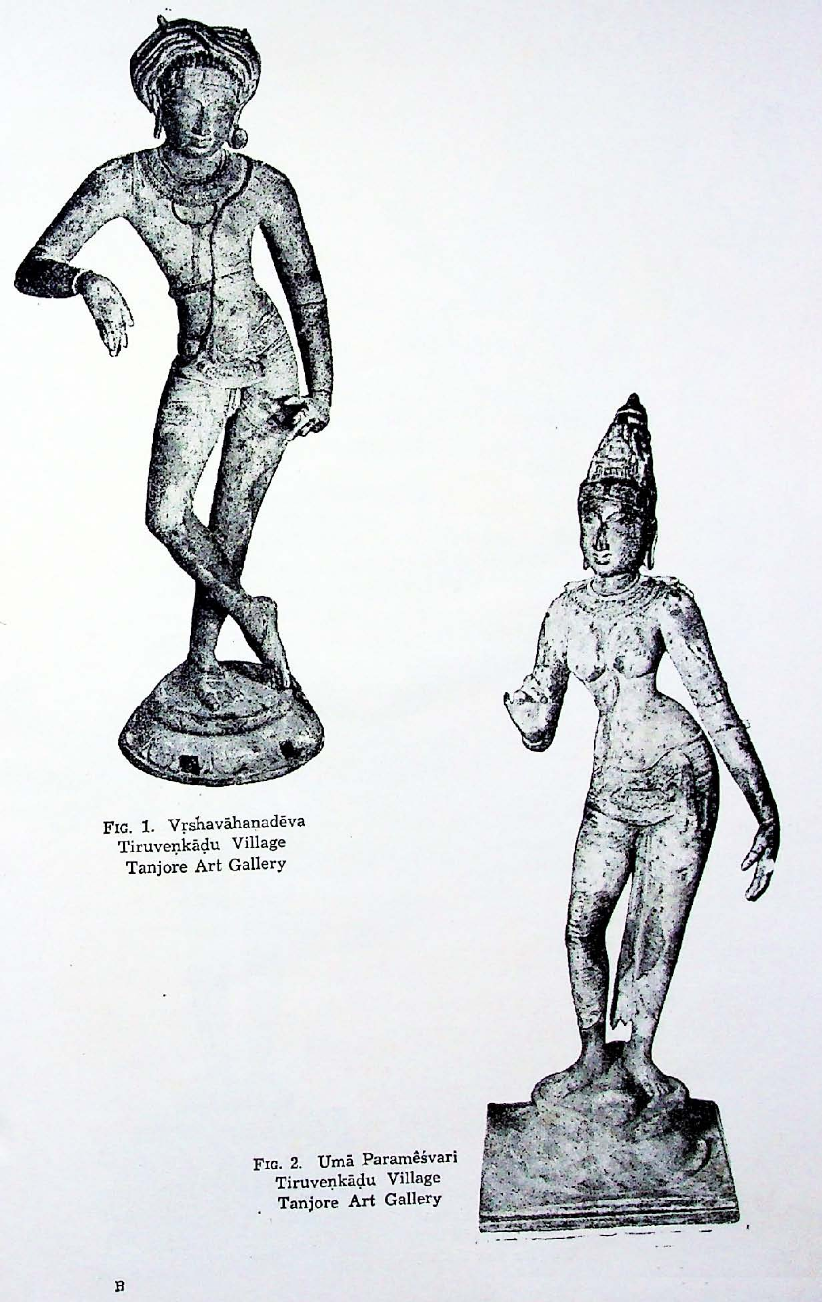
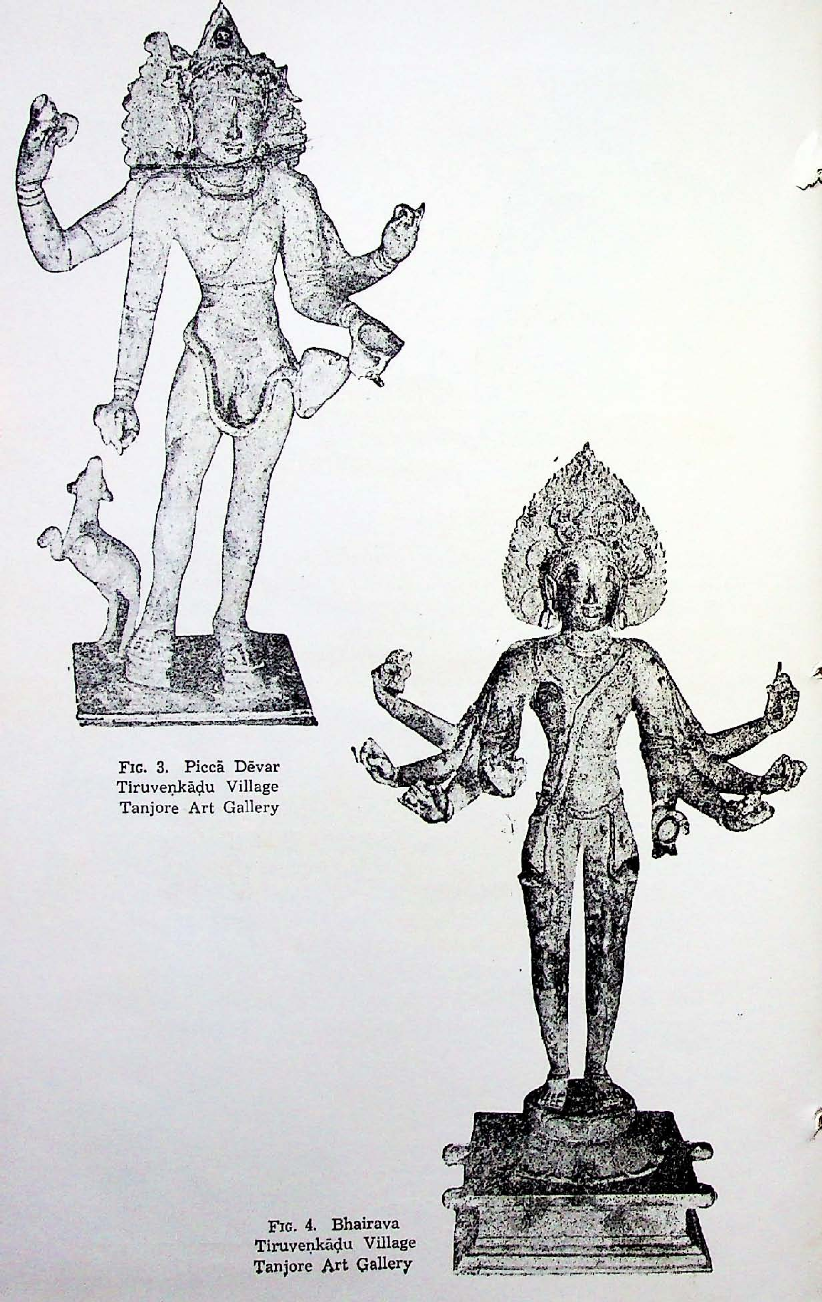
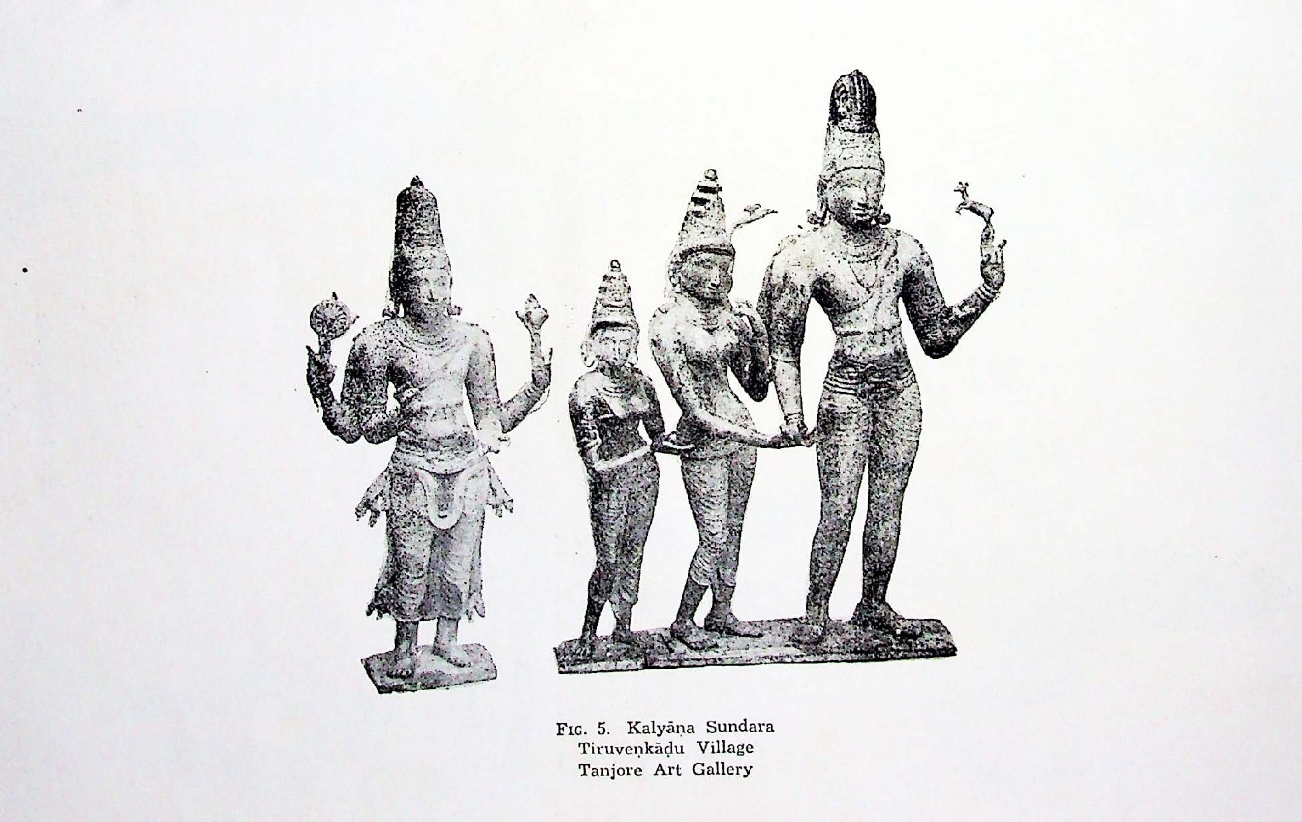
It is interesting to note that this figure comes from the Tiruveṇkāḍu village, Śīyāḻi Taluk, from where a group of rare bronzes which are now housed at the Tanjore Art Gallery were unearthed a few years ago. This earlier find includes the most graceful Vṛṣabhavāhanadēva (Fig. 1), Umāparamēśvarī (Fig. 2), Piccādēvar (Bhikṣāṭana) (Fig. 3), Bhairava (Fig. 4) and Kalyāṇasundara (Fig. 5).
Fig. 1.abc Vṛṣabhavāhanadēva · Fig. 2.ab Umā Paramēśvarī — Tiruveṇkāḍu Village, Tanjore Art GalleryFig. 3.abc Piccā Dēvar · Fig. 4. Bhairava — Tiruveṇkāḍu Village, Tanjore Art GalleryFig. 5.ab Kalyāṇa Sundara — Tiruveṇkāḍu Village, Tanjore Art Gallery
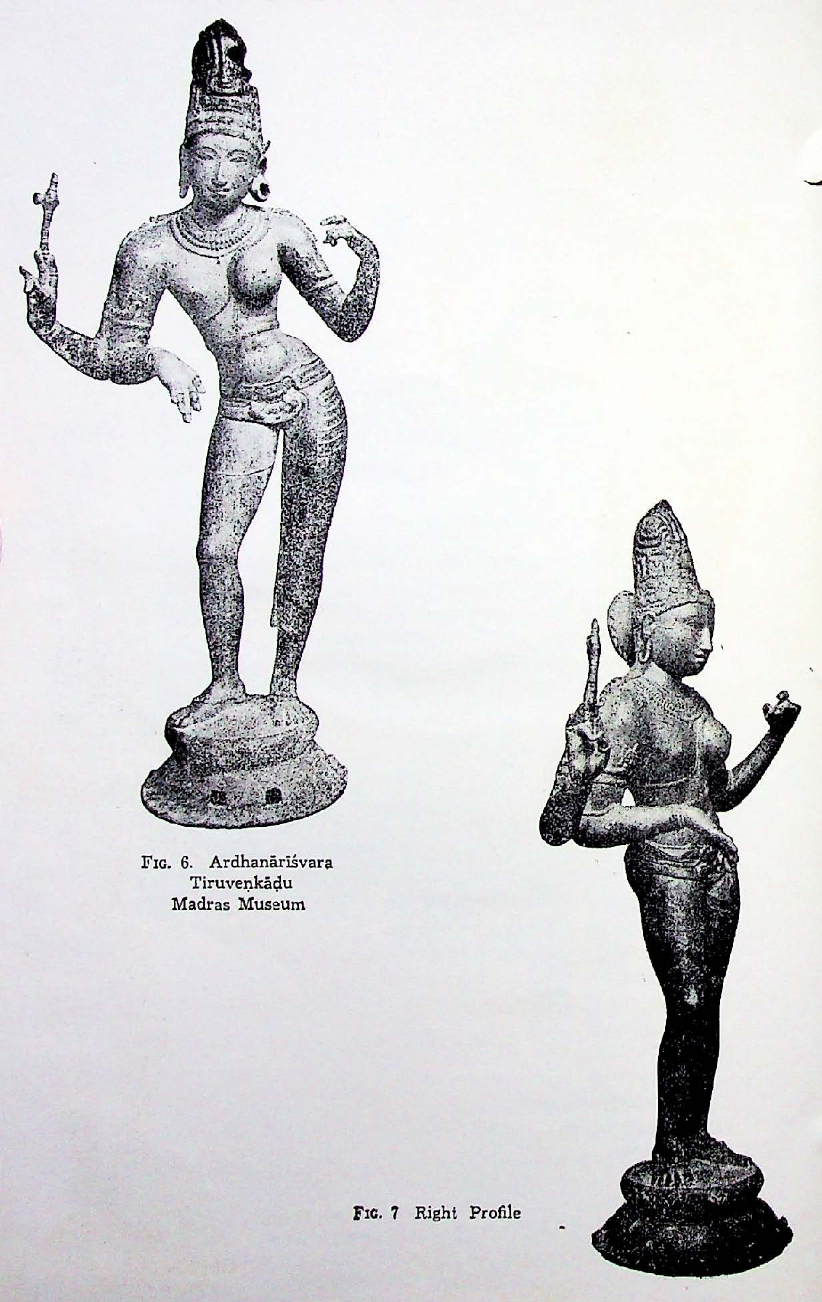
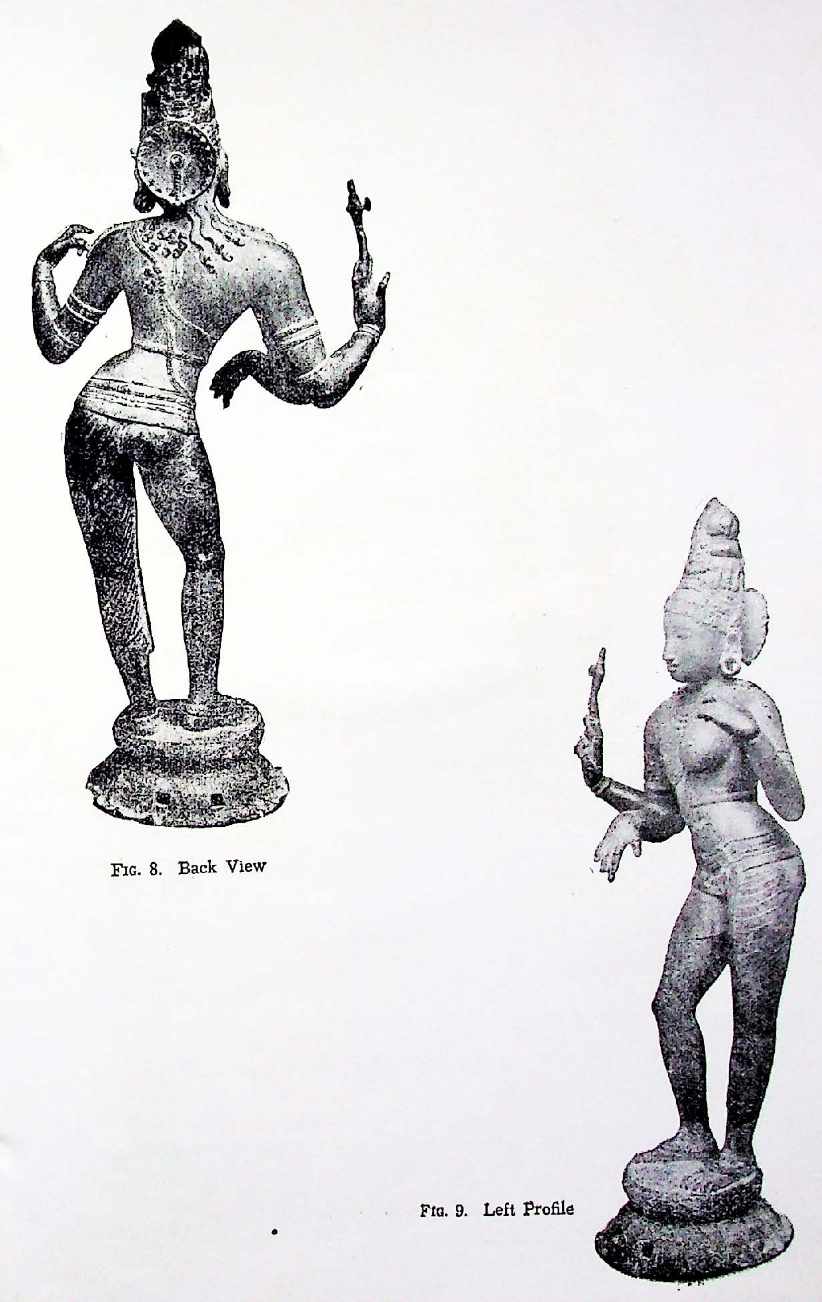
This Ardhanārīśvara is three armed and resembles the Kumbhakōṇam stone sculpture, with the right half representing the male aspect and the left the female aspect (Fig. 6). The right half of the figure is adorned with jaṭāmakuṭa with a tiny crescent moon, and the right ear bears an elongated kuṇḍala. The right upper arm holds a paraśu and the lower is bent to rest on the bull, which is not represented (Fig. 7). The right leg is slightly bent and is in the kuñcita pose. The female part of the head has its coiffure arranged as karaṇḍamakuṭa, and the left ear is adorned with patrakuṇḍala with a sprout appearing above that ear. The only left arm is in kaṭaka posture, to hold either a nīlōtpala or a mirror (Fig. 8). The prominent breast and the graceful bend at the trivali perpetuate the loveliness of feminine beauty. The garment is taken below the knee and the mēkhalā is well knit and prominent (Fig. 9). The left leg is firmly placed on the pedestal. The entire figure is well ornamented with bracelets, keyūras, kaṅkaṇas, etc., and the left half of the face is gracefully bent to the right. The figure closely follows the description given in the Uttarakāmikāgama.
Fig. 6. Ardhanārīśvara, Tiruveṇkāḍu, Madras Museum · Fig. 7. Right ProfileFig. 8. Back View · Fig. 9. Left Profile
It will be of great interest to compare this image of Ardhanārīśvara from Tiruveṇkāḍu with the graphic description of another Ardhanārīśvara bronze, decidedly of the same period, set up in the Tanjore temple during the reign of Rājarāja the Great.
“The following copper image which had been set up in the temple of the lord Śrī Rājarājēśvara until the twenty-ninth year of the king's reign by Narakkan Śrī Kṛṣṇa Rāman, alias the general (Senāpati) Mummuḍi-Chōḻa Brahmamārāyan, a Peruntaram of the Lord Śrī Rājarājadēvar (and a native) of Kēralāntaka-chaturvēdimaṅgalam in Vēnāḍu (a subdivision) of Uyyakkoṇḍār Vaḷanāḍu, was engraved on stone, after it had been measured by the cubit measure (preserved) in the temple.One solid image of Ardhanārīśvara (measuring) three quarters of a (muram) and one viral in height from the feet to the hair. The Īśvara half had two divine arms; the Umā half had one divine arm and its copper was covered with brass.One lotus on which this (image) stood, set with jewels (and measuring) two viral and a half in height.One pedestal on which this (image) stood, (measuring) three quarters (of a muram), two viral and two tolai in length, ten viral and a half in breadth, and five viral in height.One solid aureola, covering this (image and measuring) two muram and a half and two viral in circumference.”10
From the foregoing, it is evident that the Tanjore figure also had only three arms, like the Tiruveṇkāḍu figure. There is another stone figure of Ardhanārīśvara in one of the niches of the north wall of the central shrine of the same temple, and in this figure also the Īśvara half has two arms while the Umā half has only one arm. Further, a bull is represented behind the lord in the stone sculpture. But the inscription relating to the setting up of the bronze Ardhanārīśvara at Tanjore does not mention any bull. Evidently the bull was not presented along with this figure, for Rājarāja invariably mentions all the associate figures of a particular icon set up during his reign. Thus when a Vṛṣabhavāhanadēva with Umāparamēśvarī was set up during his reign, a bull was also represented in the group.11
However, on the evidence of the Ardhanārīśvara from Tiruveṇkāḍu, we may assume that the Tanjore bronze figure might have resembled the Tiruveṇkāḍu figure in all aspects, and its lower right arm also must have been in the pose of resting on the head of vṛṣabha. Another interesting and most valuable piece of information that is learnt from this inscription is that the left half of the figure was gilded with brass. The Tiruveṇkāḍu figure differs from the Tanjore bronze in as much as there is no brass gilding on the left side.
The similarity in treatment of the figures now housed at the Tanjore Art Gallery and this figure is almost striking. The jaṭāmakuṭa of this figure closely resembles the jaṭāmakuṭa of Kalyāṇasundara (Fig. 5). The right arm which is bent and is in the posture of resting on vṛṣabha is like the graceful Vṛṣabhāntika figure (Fig. 1). The left arm in the kaṭaka posture and the drapery resemble that of the Svayaṃvarā or Pārvatī figure in the Kalyāṇasundara group. The keyūra is more akin to that of the Bhikṣāṭana figure (Fig. 3).
It is most interesting to note here that12 three of the Tanjore Art Gallery figures bear inscriptional reference regarding their date of setting up in the temple; and it is of great importance, for very few South Indian bronzes have been so far dated with precision. The exceptionally beautiful and extraordinarily graceful figure of Vṛṣabhāntika of the Tanjore Art Gallery was set up during the 26th regnal year of Rājarāja the Great, who was responsible for building the most stupendous temple at Tanjore. The accompanying figure of Umā was set up during the next year. The Bhikṣāṭana, which is also now housed at the Tanjore Art Gallery, was set up during Rājēndra's time.
The following inscriptions throw welcome light on some of the important bronzes. Inscription 444, copied during 1918 by the Government Epigraphist from Tiruveṇkāḍu, records the gift of an image of Chandraśēkharadēva, made of gold and silver, by Śembiyan Mādēvi, the queen of Gaṇḍarādityadēva and mother of Uttama Chōḻa. The inscription is dated in the 6th regnal year of Rājakēsari alias Rājarāja. Unfortunately the figure has not been unearthed so far.
Another inscription13 from the same temple records that during the 26th year of Rājakēsari alias Rājarāja, a gift of money was made for the offering and jewels of Vṛṣabhavāhanadēva (Fig. 1) set up in the temple by Kōlakkāvan. During the 27th year of the same king a copper image14 of the goddess (Fig. 2), to Vṛṣabhavāhanadēva, was set up by some persons. It is certain that the Vṛṣabhavāhana and Pārvatī of the Tanjore Art Gallery were set up between 1011 and 1012 A.D.
There is another inscription15 in the same temple which records that during the 30th year of Rājakēsari alias Uḍaiyār Rājādhirājadēva, Ambalan Seyyavāyar set up the image of Piccādēvar (Bhikṣāṭana) (Fig. 3), gave lands for its requirements, presented gold and silver ornaments and obtained lands for the temple from the king's father “who was pleased to take Pūrvadēśam, Gaṅgai and Kiḍāram.” During the 27th year of the above king, gifts of silver and gold ornaments were made by the same person, Ambalan Seyyavāyar, to Piccādēvar.16 There is an obvious mistake in the inscription, for according to the reading, the image is said to have been set up during the 30th year of the reign while the gifts, etc., were made during the 27th year itself. However, the image was set up during the reign of Rājakēsari Rājādhirāja, and since the inscription mentions the king's father who was pleased to take Pūrvadēśa, Gaṅgai and Kiḍāram, he is certainly the son of Rājēndra I, who led a successful expedition to the Gangetic plain. Rājādhirāja was appointed yuvarāja very early in Rājēndra's rule, and this has been fixed as 15th March, 1018 A.D. Then the Bhikṣāṭana may be safely assigned to about 1045 A.D. It is quite possible that the same sthapati who made the immortal Vṛṣabhāntika figure might have made this also, for there is only a difference of 35 years between the setting up of Vṛṣabhavāhana and Bhikṣāṭana.
During the 15th regnal year of Tribhuvanachakravartin Rājarājadēva,17 a gift of land for offerings, flower gardens, etc., to the image of Dēvarganāyakadēva in the temple of Tiruveṇkāḍu is registered by the assembly of Kaliyugakaṇṇa Chaturvēdimaṅgalam in Ādiyamaṅgai Nāḍu. The 8th year of Rājādhirājadēva18 registers a gift of money to meet certain expenses, as burning lamps, reciting Vedas, etc., by several individuals during the procession of the god Dēvarganāyaka. There seems to be a slight error committed either by the scribe or in reading the inscription, for Dēvarganāyaka means nothing. If it could be taken to read as Dēvyardhanāyaka, then we may take it to refer to this Ardhanārīśvara bronze. In some of the inscriptions we meet with the word Dēvargaḷnāyaka, and it is just possible that the ‘ḷ’ is missing in these inscriptions. In that case the omission of the ‘ḷ’ in both the inscriptions has to be accounted for.
However, there is a specific reference to this Ardhanārīśvara in an inscription19 which is dated in the 29th year of Rājakēsari Rājādhirāja, which states that a gift of land was made by the king, seated on the flight of steps in the north of Gaṅgaikoṇḍa Chōḻan Māligai, inside the palace in Gaṅgaikoṇḍachōḻapuram, for offerings to Ardhanārīdēva in the temple of Tiruveṇkāḍu Uḍaiyār, given as dēvadāna. So it is certain that this figure was in worship prior to the 29th year of Rājādhirāja (1047 A.D.). The name of the person responsible for setting up this image in the temple of Tiruveṇkāḍu Uḍaiyār is recorded as Tuppayan Uttamachōḻi.
“நாங்கூர் நாட்டு நாங்கூர் திருவெண்காடு உடையார்கோயிலில் துப்பயந் உத்தமச் சோழி எழுந்தளுவித்தஅர்த்தநாரி தேவர்கு வேண்டும் நிவந்தங்களுக்குயாண்டு உயகூ ஆவது முதல் ஆண்டாண்டுதோறும்நிற்றிறையாய் இறுப்பதாக தெவதாநமாகவரியிலிட்டுக் குடுத்தது.”
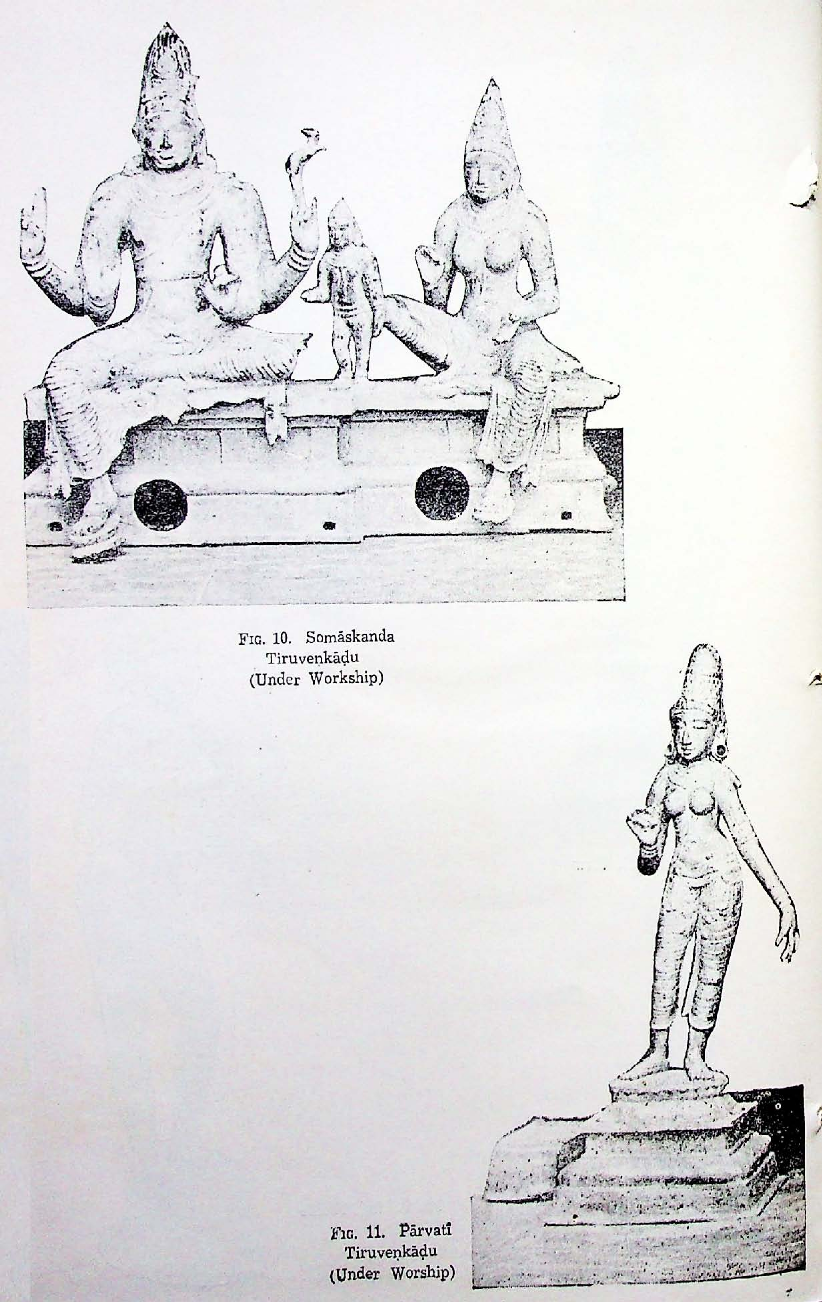
The Sōmāskanda group (Fig. 10) unearthed along with this figure is again a delightful group, full of animation, majesty and elegance. Śiva, the father of the universe, is seated with an imposing majesty, resting his left leg on the pedestal and allowing the right leg to hang.
Fig. 10. Sōmāskanda · Fig. 11. Pārvatī — Tiruveṇkāḍu (Under Worship)वामाङ्घ्रि शाययेत् पीठं दक्षिणाङ्घ्रि तु लम्बयेत् ।
The lord is four armed, holding the paraśu and mṛga in his upper pair of arms, the paraśu being broken and missing. The […] of the upper arms are in level with the shoulder — hikkā sūtra. The lower right arm is in abhaya pose while the left is in kaṭaka pose, resembling siṃhakarṇa […]. The kaṭakavalaya, the armlets called ([…]) parājita, is well treated. The upper armlet (the keyūra) is decorated with the design called […] or the leaf motif. […] or the silk garment of the Lord is exquisitely designed, with well treated folds. The face is full of divine contemplation. The jaṭāmakuṭa adds charm to the face, by just being the size of the face with a lalāṭapaṭṭa (ललाटपट्ट) or face band, receding harmoniously into a conical shaped makuṭa.
......... ललाटपट्ट संयुतम् ।मुखान्तसदृशं विप्र मकुटमूल विशालकम् ॥
The whole figure is vigorously treated with rājasic quality. On the left of Śiva is Pārvatī seated, with two arms.
देवस्य वामभागे तु पार्वतीं च सुखासनाम् ।
The right leg of the dēvī is placed on the pedestal, while the left hangs. The right arm is in the kaṭaka pose to hold a nīlōtpala and the left is in varada pose. The silken garment is also treated with folds. The well-treated breasts, the smiles, the charming face, bearing on its eyebrows the sacred motherhood, make this dēvī the most superb specimen of South Indian art.
The delightful, rather bashful face of this young mother, slightly turned towards the lord (Āgamas do prescribe such a portrayal), at once reminds us of Kālidāsa's immortal portrayal of Sudakṣiṇā, the wife of Dilīpa, on the birth of Raghu.
“Like the affection of the cakravāka birds, the love of Dilīpaand Sudakṣiṇā grew in leaps and bounds towards each other,though there is now the son to partake of it.”— Raghuvaṃśa 3-24रथाङ्गनाम्नोरिव भावबन्धनं बभूव यत् प्रेम परस्पराश्रयम् ।विभक्तमप्येकसुतेन तत्तयोः परस्परस्योपरि पर्यचीयत ॥— रघुवंश ३-२४
Whom does the great poet cite as an example? He cites only Sōmāskanda as an example of this. In the previous verse of the same sarga the poet says, “Like Śiva and Umā, they delighted in the company of each other”.
उमावृषाङ्कौ शरजन्मना यथा यथा जयन्तेन शचीपुरन्दरौ ।तथा नृपः सा च सुतेन मागधी ननन्दतुस्तत्सदृशेन तत्समौ ॥— रघुवंश ३-२३
The Dēvī is no more that Pārvatī who, when her marriage was proposed with Śiva, stood by the side of her father with her face flooded with bashfulness and looking down counting the lotus petals.
एवं वादिनि देवर्षौ पार्श्वे पितुरधोमुखी ।लीलाकमलपत्राणि गणयामास पार्वती ॥— कुमारसम्भव
But she is now a happy mother, looking at her lord full of affection and love.
In between this divine pair stands the little Skanda with two arms; the quarters alone are his dress; he is a little child, with his left hand in lōla hasta and the right in sūci hasta. The figure is delineated with all boyish pranks. The whole group is mounted on a bhadrāsana.
If any convincing proof as to its age is required, reference may be made to the jaṭāmakuṭa of Śiva in this group and the jaṭāmakuṭa of Śiva represented in the Kalyāṇasundara group of bronzes, also unearthed at Tiruveṇkāḍu and now housed at the Tanjore Art Gallery. They are almost identical, and if the suggestion is accepted, both the earlier and later finds of bronzes from Tiruveṇkāḍu come from one and the same master sthapati, whose name will remain anonymous for ever.
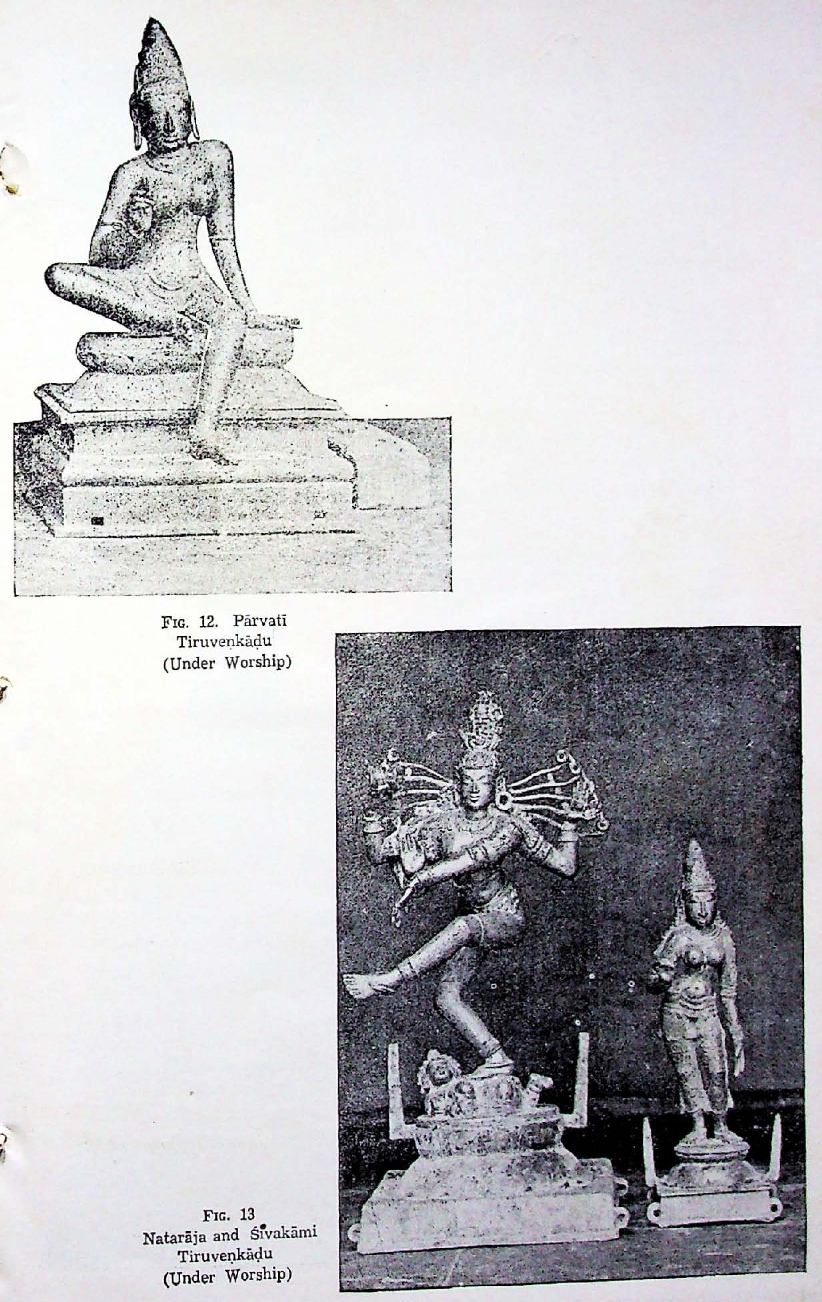
There are altogether three Pārvatī figures (Figs. 11 & 12), two in the standing posture and one seated. One standing Pārvatī figure is the consort of Naṭarāja, which was also unearthed along with this group, while the other two were most probably set up as consorts of other icons, which have not been recovered so far. The seated figure is probably an Umā in an Umā Sahita group. These bronzes are also in the same best traditions as the other figures.
The Naṭarāja figure (Fig. 13) unearthed with these figures is the most important find, for more than one reason. The figure, like any other Naṭarāja, is dancing on Muyalaka, on a padmāsana over a bhadrapīṭha, with lugs on either side to receive the tiruvāśi. The upper right arm is slightly above the right shoulder, probably because, in the rhythm of the dance, it assumes this position. The dance is so charming and fascinating that even the Muyalaka at the foot of the lord, though being crushed, looks up to the lifted pāda of the lord with dismay and wonder. Out of all the dwarf figures so far known to us, this seems to be the most suggestive and impressive figure.
The jaṭāmakuṭa of Naṭarāja is intricately chiselled, but is to a certain degree disproportionately long. However, one thing that is very striking is the treatment of jaṭās. The flowing jaṭās on either side are connected with each other with some semicircular motifs, and what is more, they are nine in number. During the reign of Rājarāja the Great, a copper image of Naṭarāja was set up at the Tanjore Temple, wherein the figure is said to have had nine flowing jaṭās. It will therefore be interesting here to note the description of the Naṭarāja set up in the Tanjore Temple.
“The following copper images were set up in the temple of the Lord Śrī Rājarājēśvara, until the 29th year of the King's reign by Śōṛamādēviār, the consort of our lord, Śrī Rājarājadēva. One solid image of Aḍavallār, having four divine arms, the goddess Gaṅgābhaṭṭāraki on the braided hair, nine braids of hair (jaṭā), and seven flower garlands (pūmālai) and measuring together with the image of Musalagan, who was lying on the ground, three quarters and one eighth of a muṟam in height from the feet to the hair.”20
Turning to the present figure, it may be observed that the general character of Naṭarāja icons during the reign of Rājarāja the Great was akin to the Naṭarāja from Tiruveṇkāḍu. An inscription in the Tiruveṇkāḍu temple states that during the 28th regnal year of Rājakēsarivarman alias Rājarāja, a gift of gold offerings was made to the idol of Aḍavallār by Kuttanvirāṇiar, a queen of the king.21 It is likely that the reference in this case is to the present figure, and this figure might be ranked with the few early dated bronzes of South India.
Fig. 12. Pārvatī · Fig. 13. Naṭarāja and Śivakāmi — Tiruveṇkāḍu (Under Worship)
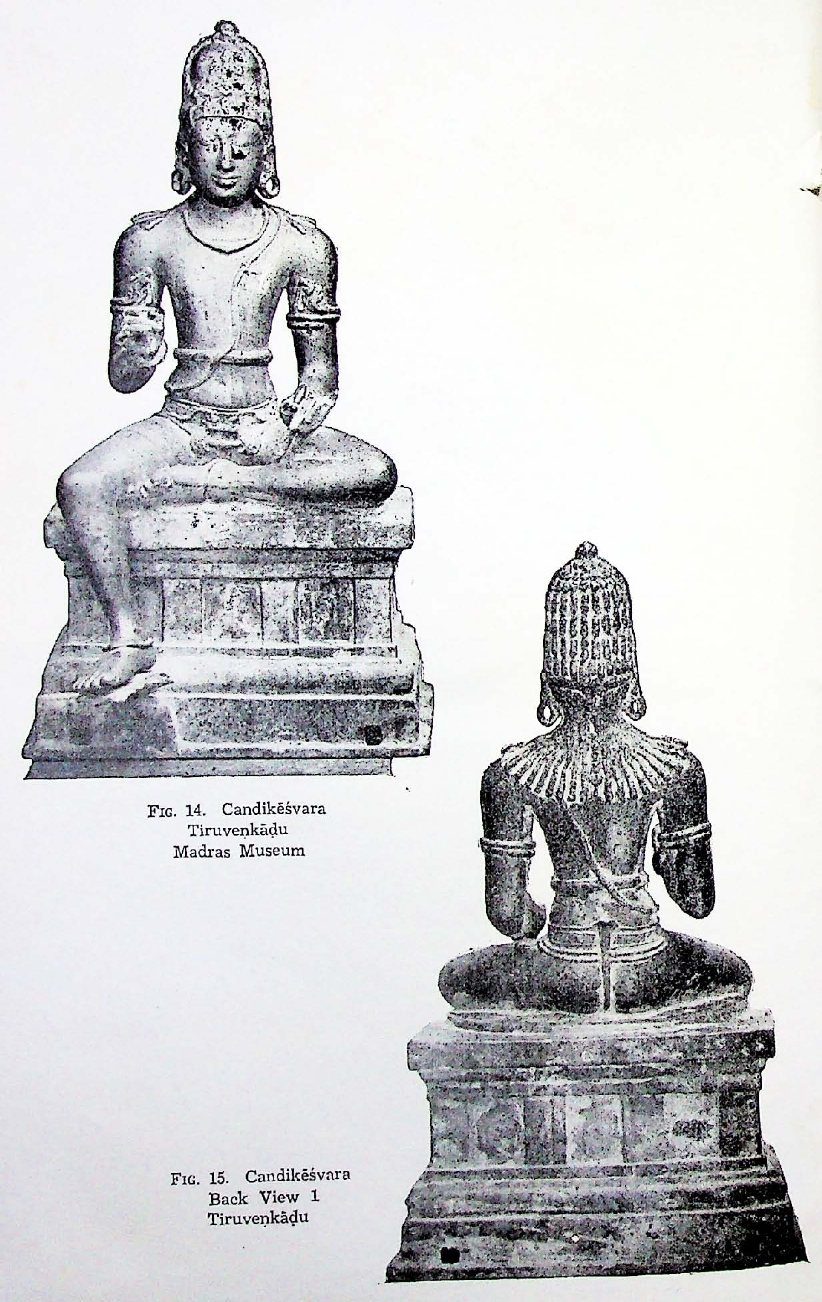
Another interesting figure coming from Tiruveṇkāḍu is the seated figure of Caṇḍikēśvara (Fig. 14) with two arms. The left leg of the figure is bent and rested on a pedestal and the right leg hangs down, into the pāda supported by a realistically treated lotus. The right leg was probably broken below the ankle even during the time of its manufacture, for signs of welding could be noticed around the portion, and the lotus flower was probably introduced to act as an additional support. The right arm of the figure is in kaṭaka pose to hold the paraśu and the left is in āhūyavarada pose. The head bears a beautifully treated jaṭāmakuṭa with a row of flowers arranged in the front, which recalls to our mind the wreath of flowers placed around the kirīṭa by Lord Śiva in the Caṇḍēśa-anugrahamūrti figure. The jaṭāmakuṭa is also crowned by a flower (Fig. 15), and the earlobes bear patrakuṇḍalas. The face is extraordinarily graceful. A singular hārā adorns the neck, and the keyūras, kaṅkaṇas, etc., are prominently treated with great realism. The soft and delicately rounded limbs are undoubtedly from a master craftsman, and since this was found along with the Ardhanārī and other figures, it may also be ascribed to the same period.
Fig. 14. Caṇḍikēśvara, Tiruveṇkāḍu, Madras Museum · Fig. 15. Caṇḍikēśvara, Back View, Tiruveṇkāḍu
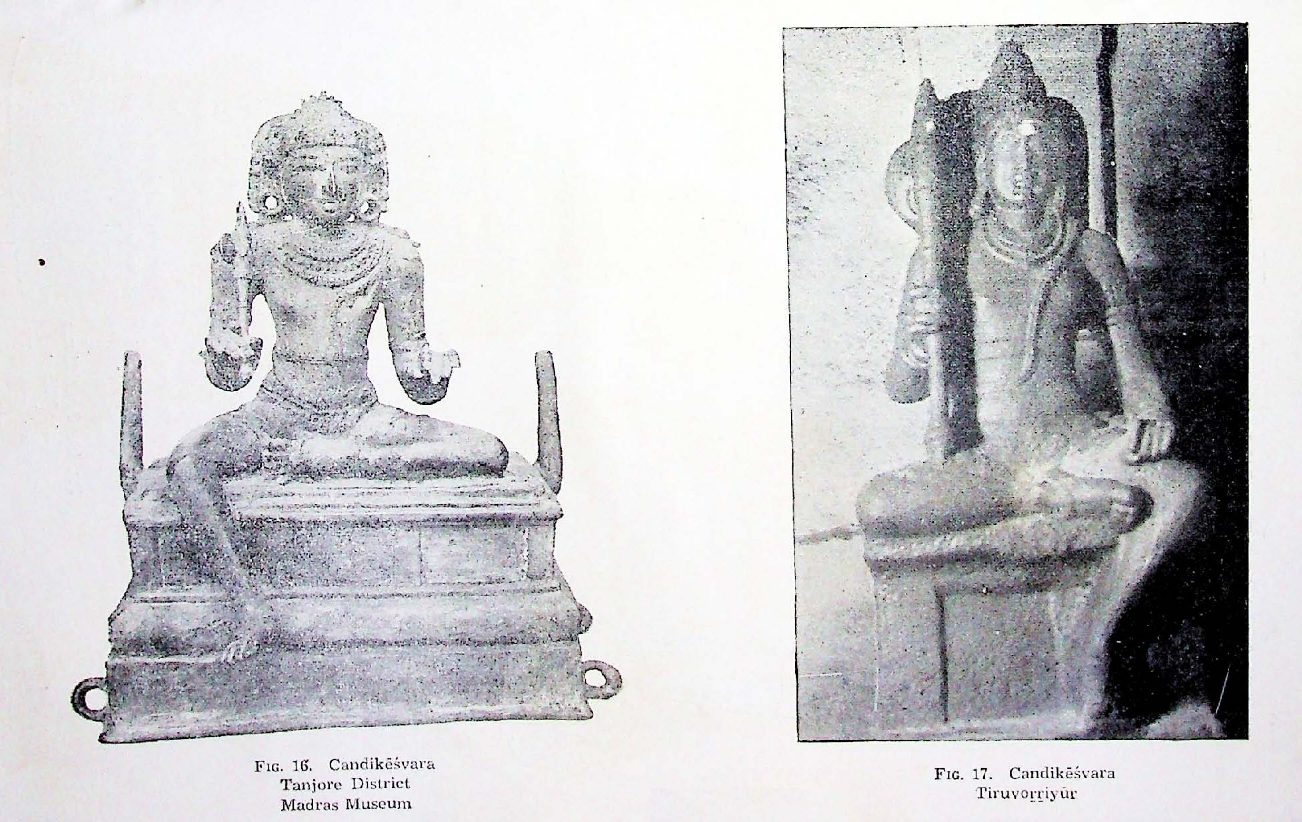
No such remarkable piece of seated Caṇḍēśvara has so far been reported, except perhaps the seated figure22 in the Madras Museum Collection (Fig. 16), identified as Aiyanār. Seated figures of Aiyanār are uncommon, and this particular bronze in the Madras Museum bears kēśabandha instead of the jaṭāmakuṭa usually seen in Caṇḍēśvara figures. This figure was acquired as a treasure trove find from the Tanjore District, and the kēśabandha resembles the treatment of hair in Aiyanār figures. The identification of the above figure as Aiyanār is doubtful, and in the light of the Tiruveṇkāḍu seated figure, it may be identified as Caṇḍikēśvara. Though the Caṇḍikēśvara bronzes so far brought to light are standing figures, the Tiruveṇkāḍu figure supplies the seated example. It is too well known that the stone sculptures of Caṇḍikēśvara in Śiva temples are mostly seated, the best illustration being the figure from Tiruvoṟṟiyūr temple (Fig. 17).
Fig. 16. Caṇḍikēśvara, Tanjore District, Madras Museum · Fig. 17. Caṇḍikēśvara, Tiruvoṟṟiyūr
Secondly, the paraśu is never associated with Aiyanār, while it is always associated with Caṇḍēśvara. The Aiyanār figure holds a bill hook or elephant goad as its symbol. This seated figure holds a paraśu in the right arm, while the left arm, like the Tiruveṇkāḍu figure, is in the āhūyavarada pose. Though the paraśu is not represented in the Tiruveṇkāḍu figure, the position of arms and the mudrās of both these bronzes are almost identical.
It becomes therefore necessary to explain only one aspect to support my identification of this figure as Caṇḍēśvara, and that is the treatment of the kēśa. I must admit that the treatment of the kēśabandha is quite unusual in this figure, for most of the Caṇḍēśvara figures, as already noted, bear jaṭāmakuṭa. But jaṭāmakuṭa is not invariably associated with the Caṇḍēśvara figure, for there are examples which bear other forms as well. In the Āgamas we meet with the description of Caṇḍēśvara as jaṭila, one with braided hairs, jaṭājūṭaśēkhara, or as one who has kēśabandha.
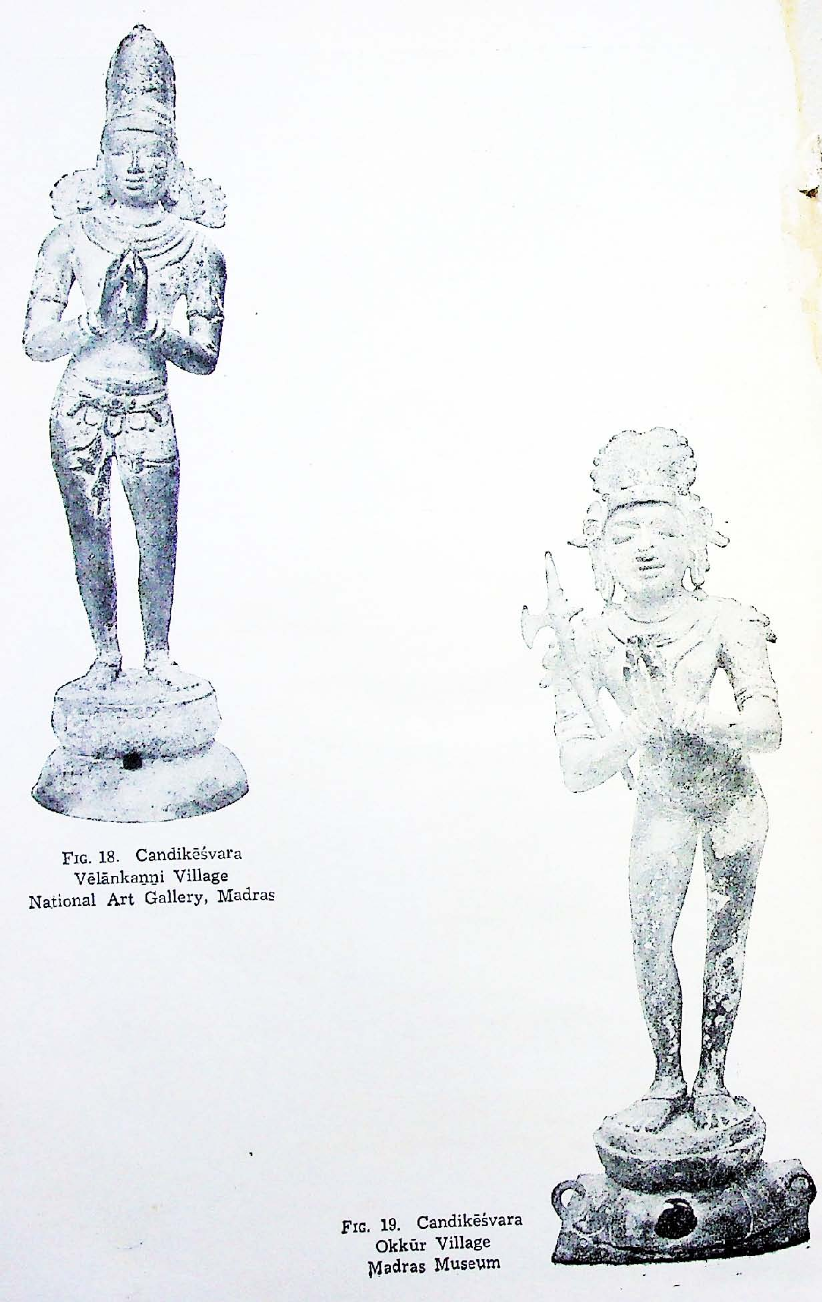
Turning to actual specimens, the bronze figure of standing Caṇḍēśvara23 now housed in the National Art Gallery, Madras (Fig. 18), gives an interesting example, for though it bears jaṭāmakuṭa, the kēśa is spread on either side below the makuṭa, being tied at the back with a ribbon. Here we have an example having both jaṭāmakuṭa and kēśabandha associated with this icon. There is another figure of Caṇḍikēśvara in standing posture, from Okkūr, which is also now in the Madras Museum (Fig. 19). There could be no doubt about the identification of this figure, for like all the other figures, it holds a paraśu across its right arm. The most interesting point here is the treatment of the hair, which is in the form of kēśabandha and not as jaṭāmakuṭa.
Fig. 18. Caṇḍikēśvara, Vēḷāṅkaṇṇi Village, National Art Gallery, Madras · Fig. 19. Caṇḍikēśvara, Okkūr Village, Madras Museum
There is an interesting seated figure at the Rājasiṃhēśvara or Kailāsanātha temple of Kāñcīpuram. The figure, bearing a terrible countenance, is seated in the vīrāsana pose, with its left leg hanging down and the right resting on the pedestal. The left arm is resting on the right foot in the dhyānamudrā. Since the right arm is broken from the shoulder, it is not possible to ascertain the pose of the right arm. The kēśa is spread on either side of the head. The figure, which is about 4′ in height, is in full round and is carved with heavy ruggedness. It is the only figure made of a single stone in the Kailāsanātha temple and has also suffered from the plastering. That this figure represents Caṇḍēśvara is clearly borne out by another similar figure, which is a small replica of this seated figure. It is carved in relief on the wall, just at the back of this seated figure, and since it holds a paraśu in its right arm, there is no difficulty in the above identification.
There are two types of Caṇḍēśvara according to the Āgamas, called svatantra and paratantra. The svatantra figure is endowed with a separate shrine, while the paratantra is usually placed in the Śiva temple at the North Eastern corner, facing south, and bears the title of Vīracaṇḍēśa. Vīracaṇḍēśa should be represented with two hands and should bear a terrible countenance. The seated figure in the Kailāsanātha temple is placed in the North Eastern corner, facing south, and fully testifies to the description of the Āgamas. The reference to this figure and its identification† becomes all the more interesting because of the treatment of kēśa in it. The kēśabandha of this Vīracaṇḍēśa is exactly similar to the seated bronze figure in the Madras Museum identified as Aiyanār.
Notes* Paper read at the meeting of the Society on 12th December, 1960.1. T. A. Gopinatha Rao, Elements of Hindu Iconography, Vol. II, Pt. I, Pl. XLIV.2. Ibid., Pl. XLVII.3. Heimo Rau, Die Kunst Indiens, 95.4. T. A. Gopinatha Rao, op. cit., Pl. XCV, Fig. 2.5. Ibid., Pl. XCV, Fig. 1.6. P. Z. Pattabiramin, Quatre Vieux Temples des Environs de Pondichéry, Pl. XXXIV.7. T. A. Gopinatha Rao, op. cit., Pl. XVI, Fig. 2.8. H. Krishna Sastri, South Indian Gods and Goddesses, Fig. 80.9. Dr. F. H. Gravely and T. N. Ramachandran, Catalogue of Hindu Metal Images, Pl. XX, Fig. 2. Also T. A. Gopinatha Rao, op. cit., Pl. XCVI.10.South Indian Inscriptions, Vol. II, No. 39.11. Ibid., No. 46.12. T. N. Ramachandran, Lalit Kalā, No. 3.13.Annual Report on Epigraphy, 456 of 1918.14. Ibid., 457 of 1918.15. Ibid., 450 of 1918.16. Ibid., 401 of 1918.17. Ibid., 470 of 1918.18. Ibid., 502 of 1918.19. Prof. K. A. Nilakanta Sastri, The Cōḷas, Vol. I, p. 576; A.R.E. 114 of 1896; S.I.I. Vol. V, 978.20. S.I.I. Vol. II, No. 42.21. A.R.E. 449 of 1918.22. Dr. F. H. Gravely and T. N. Ramachandran, op. cit., p. 128, Fig. 4. (Also O. C. Gangoly 2, Pl. VI, identified as Dakṣiṇāmūrti.)23. Ibid., No. 2, p. 130.† I am indebted to Sri K. R. Srinivasan, the Superintendent, Temple Survey Projects of the Archaeological Survey of India, for the above identification.